Why Employers Are Slowing Hiring Heading Into Q4 2026
ALT: Employers slowing hiring ahead of Q4 2026 amid economic uncertainty and rising costs
For educational purposes only. Not investment advice.
- Three core points emerge from this analysis of why employers are pulling back on hiring as Q4 2026 approaches.
- First, the slowdown is real but uneven. It is concentrated in white-collar and office functions, and it reflects a convergence of elevated borrowing costs, AI integration, and budget conservatism rather than a single cause. Understanding which force is most relevant to your sector matters for making sense of what you're seeing.
- Second, structural forces are at work alongside cyclical ones. Even when interest rates eventually come down, some of the roles being left unfilled today may not come back in the same form. AI is reshaping role structures in ways that are beginning to show up in actual hiring behavior, not just in headlines about technology.
- Third, for individuals, the practical response is to focus on specificity and adaptability. Job seekers who understand what employers are actually trying to solve — not just what the job description lists — and who can demonstrate concrete value are better positioned in a selective market. Employees who invest in skills that complement automation, rather than compete with it, are making a smart long-term move.
- The job market is telling a story right now, and reading it clearly — rather than through the lens of either panic or complacency — is exactly the kind of financial and economic literacy that helps individuals make better decisions for themselves and their families.
- If you want to stay ahead of economic shifts like this one without having to decode dense financial reporting, start making sense of today's headlines in plain English. Head over to Vega Brief — where complex economic news gets translated into clear, source-backed explanations you can actually use.
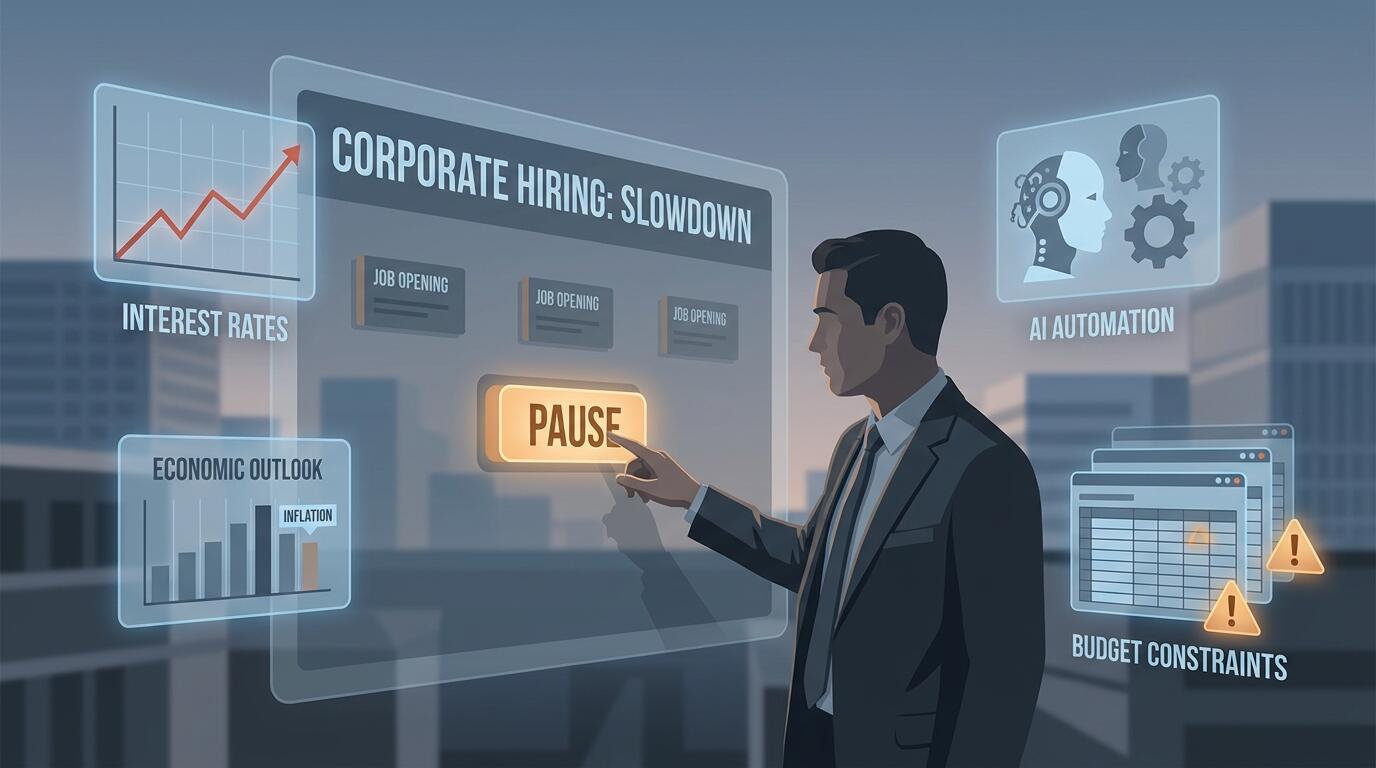
ALT: Employers slowing hiring ahead of Q4 2026 amid economic uncertainty and rising costs
The Hiring Slowdown That's Hard to Miss: What's Really Happening in the Job Market
You send in a job application and hear nothing for weeks. A friend who was interviewing at three companies simultaneously finds that two of them have suddenly "paused" their searches. A manager at a mid-sized company tells you that headcount approvals are taking longer than ever. These are not isolated anecdotes — they reflect a broader pattern visible across industries as businesses pull back on hiring heading into the final quarter of 2026.
The core finding is this: employers across a wide range of sectors are deliberately slowing the pace at which they bring on new workers, and several interconnected forces — economic uncertainty, elevated borrowing costs, AI-driven workforce restructuring, and tightening corporate budgets — are driving that caution. Understanding why this is happening matters not just for job seekers but for anyone trying to make sense of where the economy is heading.
This is precisely the kind of economic signal worth paying closer attention to right now, because a deceleration in hiring is often an early indicator of broader shifts in how businesses see their own financial future.
How We Got Here: The State of the Labor Market Entering Q4 2026
The labor market that exists heading into Q4 2026 looks very different from the one employers navigated just two years ago. After a period of intense competition for workers — when businesses were posting record numbers of open positions and offering signing bonuses, remote flexibility, and elevated salaries to attract talent — the mood has shifted noticeably.
Hiring velocity, which refers to the speed at which employers move candidates through the recruiting pipeline and ultimately make offers, has slowed across many sectors. According to staffing industry analysis, employers are extending decision timelines, reducing the total number of open roles they post publicly, and in some cases freezing hiring entirely for non-critical positions.
This pullback is not universal. Healthcare, certain areas of technology, and skilled trades continue to see robust demand. But in white-collar office functions — finance, marketing, HR, operations, and middle management — the picture has changed dramatically. The frenzied hiring of the post-pandemic rebound has given way to something more deliberate, more cautious, and in many cases, more restrictive.
WFA Staffing's analysis of 2026 hiring trends captures a telling dynamic: companies that were building out large teams just 18 months ago are now focused on efficiency rather than headcount growth. The question employers are asking has shifted from "How do we find enough people?" to "Do we actually need this role filled right now?"
Part of the explanation lies in where the broader economy stands. Interest rates remain elevated by historical standards — a consequence of the Federal Reserve's sustained effort to bring inflation under control over recent years. To understand how those rate decisions ripple through corporate hiring budgets, it helps to know that higher borrowing costs make expansion more expensive for businesses. As the Federal Reserve's rate decisions affect not just mortgages and savings but the entire cost structure of running a business, companies are recalibrating how aggressively they invest in growth — and new hires are a direct form of investment.
The Root Causes: Why Employers Are Pumping the Brakes
Employers slowing their hiring pace heading into Q4 2026 is not the result of one single cause. It is the product of several reinforcing pressures that, together, make caution the rational choice for many business leaders.
The Cost of Capital Has Changed the Math
When borrowing money is cheap, expansion feels relatively low-risk. A company can take on debt to fund a new division, hire the team to staff it, and bank on future revenue to justify the spend. When interest rates are high, that calculation changes fundamentally. The cost of capital — the price a business effectively pays to fund its operations and growth, whether through loans, bonds, or equity — rises, making speculative hiring decisions harder to justify.
Businesses that carry debt are also seeing higher interest expenses eat into their margins, which leaves less room for discretionary spending like workforce expansion. This dynamic is particularly acute for small and mid-sized companies that relied on low-rate environments to fuel their growth.
AI and Automation Are Reshaping Role Structures
One of the most significant structural forces at play is the rapid integration of artificial intelligence into everyday business workflows. Automation, in this context, refers to the use of software — including AI-powered tools — to perform tasks that previously required human labor. As leoforce's workforce planning analysis notes, many employers are deliberately holding roles open while they assess which tasks can be handled by AI, rather than immediately backfilling with a human hire.
This is not just about cost savings. It reflects a genuine uncertainty about what the workforce of 2027 and beyond will look like. Companies that move too quickly to hire may find themselves restructuring again within months. So instead, they wait, observe, and experiment — which shows up in the hiring data as a slowdown. The broader implications of this trend connect directly to how AI investment is reshaping global growth trajectories heading into 2027, with productivity gains increasingly substituting for headcount growth.
Budget Uncertainty Is Driving Corporate Conservatism
Corporate conservatism in hiring refers to a deliberate strategy of restraint — keeping headcount lean until there is greater clarity about revenue, costs, and the economic environment. Heading into Q4, many companies are in the middle of annual budget planning cycles for the following year. Decision-makers who are uncertain about what 2027 will look like are reluctant to commit to new salaries, benefits, and training costs that come with every new hire.
This is a pattern we consistently see in environments where macroeconomic signals are mixed: inflation is cooling but not fully tamed, consumer spending is holding up but showing cracks, and global trade dynamics remain unsettled. In that environment, the default corporate response is to wait.
The Skills Gap Is Creating a Different Kind of Friction
Not all of the slowdown reflects demand dropping away. Some of it reflects a mismatch between the skills employers need and the candidates available in the market. The skills gap — the difference between what employers require and what job seekers currently offer — has widened in technical and digital roles, making it harder and more expensive to find qualified candidates quickly.
When finding the right person takes three times as long as expected, some employers choose to restructure internally rather than extend an open search indefinitely. That shows up in the numbers as fewer posted roles and slower hiring velocity, even when the underlying need for talent hasn't necessarily disappeared.
Geopolitical and Trade Uncertainty Are Adding Another Layer
Global trade disruptions, tariff concerns, and geopolitical instability have introduced another layer of planning risk for businesses with international exposure. Supply chain volatility — unpredictable swings in the availability and cost of goods needed for production — makes it difficult to forecast revenue accurately, which in turn makes it difficult to commit to headcount targets. Companies operating in manufacturing, logistics, and export-dependent industries are particularly sensitive to this kind of uncertainty.
Evidence and Competing Perspectives: Is This a Pause or a Pullback?
Not everyone reads the current hiring deceleration the same way. It is worth examining the different interpretations of what is happening and what each one implies.
ManpowerGroup's Q4 global hiring outlook data reveals that employer confidence is diverging sharply by region and industry — with some sectors signaling continued growth while others are actively contracting. This is not a simple story of universal retrenchment. It is a more nuanced picture of selective caution.
Analysts who take a more optimistic view argue that what we are seeing is a normalization — a return to more sustainable hiring rates after an unusual post-pandemic surge. On this reading, the slowdown is healthy, and the labor market is finding a natural equilibrium rather than tipping into recession territory.
A more cautious interpretation holds that the slowdown reflects something structural: businesses are not just adjusting their pace but fundamentally re-examining how many people they need. If AI and automation continue to advance at their current pace, the demand for certain categories of workers may not return to previous levels even when economic conditions improve.
A third perspective focuses on the cyclical explanation: high interest rates suppress investment and hiring, and when rates eventually come down, businesses will be ready to expand again. On this view, the current slowdown is temporary and largely interest-rate-driven.
Perspective / Approach — Strengths — Trade-offs — Best Fit
Normalization view — Supported by strong underlying employment levels; avoids alarm — May underestimate structural shifts from AI adoption — Sectors with stable demand and traditional workflows
Structural change view — Accounts for AI displacement of roles; explains persistent gaps — Hard to quantify; risks overstating tech impact in near term — Technology-adjacent industries and white-collar office work
Cyclical / rate-driven view — Grounded in historical patterns of rate-cycle effects on hiring — Assumes rate cuts will fully restore demand; ignores new dynamics — Capital-intensive sectors highly sensitive to borrowing costs
Each of these perspectives captures a real part of the picture. The most honest answer is that all three forces are operating simultaneously — which is part of why the overall signal is so difficult to read cleanly.
What This Means: Where the Hiring Market Is Likely Heading
The hiring slowdown heading into Q4 2026 is unlikely to reverse sharply in the short term. Several of the underlying forces — budget conservatism, AI integration, skills mismatch — are structural rather than cyclical, meaning they will not simply resolve themselves when economic conditions shift.
For job seekers, this means navigating a more selective market that rewards specificity and demonstrated skill over broad experience. Roles are being filled more carefully, with longer interview processes and more rigorous evaluation of exactly what value a new hire will contribute from day one. Candidates who can point to tangible, specific outcomes in previous roles will have a meaningful advantage over those with general credentials.
For workers already employed, this environment reinforces the value of upskilling — particularly in areas where AI tools are becoming part of standard workflows. Employees who learn to work alongside automation rather than compete with it are likely to be viewed as higher-value contributors, which matters for job security in an environment where companies are scrutinizing every line of their cost structure.
For people watching the broader economy, the hiring slowdown is a signal worth tracking alongside inflation figures, consumer confidence data, and corporate earnings reports. Hiring activity is often described as a leading indicator of economic health — meaning it tends to shift before the broader economy does. A sustained deceleration in hiring can foreshadow slower GDP growth, reduced consumer spending, and eventually, a broader economic softening.
That said, the picture is not uniformly grim. Sectors with structural labor shortages — healthcare, skilled trades, infrastructure — are still hiring actively. And companies that have been investing heavily in AI infrastructure are beginning to create new categories of roles around managing, auditing, and deploying those systems. The job market is not shrinking equally across the board; it is shifting.
ALT: Chart showing employer hiring slowdown trends across sectors heading into Q4 2026 amid economic and workforce restructuring pressures
Q1: How does a hiring slowdown differ from a recession in the job market?
A hiring slowdown means employers are adding new workers more slowly — posting fewer jobs, taking longer to fill open roles, or freezing non-essential positions. A recession in the job market, by contrast, typically involves active job losses: layoffs, reductions in force, and rising unemployment. A slowdown is a deceleration, not a reversal. Heading into Q4 2026, the evidence points to caution and restraint rather than widespread cuts, though the line between the two can blur if conditions deteriorate further.
Q2: Are all industries experiencing this slowdown equally?
No — the hiring deceleration heading into Q4 2026 is concentrated in specific sectors rather than spread evenly across the economy. White-collar office functions, middle management, and roles with significant overlap with AI capabilities are seeing the most significant pullback. Healthcare, skilled trades, and infrastructure-related roles continue to see solid demand due to structural shortages that technology has not yet addressed. ManpowerGroup's global hiring data shows this divergence clearly, with employer confidence varying substantially by region and industry.
Q3: How long could this hiring slowdown last?
The duration of the current slowdown depends on which forces are driving it most strongly. If the primary cause is elevated interest rates, history suggests hiring should pick up as rates decline and borrowing costs fall. If the deeper cause is structural — AI adoption reshaping what roles businesses actually need — recovery in specific job categories may take longer and be incomplete. Most workforce planning analysts suggest that employers are unlikely to return to aggressive hiring mode until there is greater clarity on both the economic outlook and the practical boundaries of AI automation in their industries.
Sources & Further Reading
ManpowerGroup. "Global Hiring Outlook Strengthens for Q4 as Workforce Transformation Accelerates."
https://investor.manpowergroup.com/news-releases/news-release-details/global-hiring-outlook-strengthens-q4-workforce-transformation
WFA Staffing. "Preparing for Q3 & Q4: 2026 Hiring Trends Employers Should Be Thinking About Now."
https://wfastaffing.com/preparing-for-q3-q4-2026-hiring-trends-employers-should-be-thinking-about-now/
Leoforce. "Three Hiring Trends Shaping Q4 2026 and Workforce Planning for 2027."
https://leoforce.com/three-hiring-trends-shaping-q4-2026-and-workforce-planning-for-2027/
U.S. Bureau of Labor Statistics. Job Openings and Labor Turnover Survey (JOLTS).
https://www.bls.gov
For educational purposes only. Not investment advice. We do not recommend any stock, fund, broker or trading platform. Headlines are sourced from Google News · Business; every story links to the original publishers.