What the 2026 Midterms Could Mean for Your Taxes, Social Security and Mortgage Rates
ALT: 2026 midterm elections impact on taxes Social Security and mortgage rates for everyday Americans
For educational purposes only. Not investment advice.
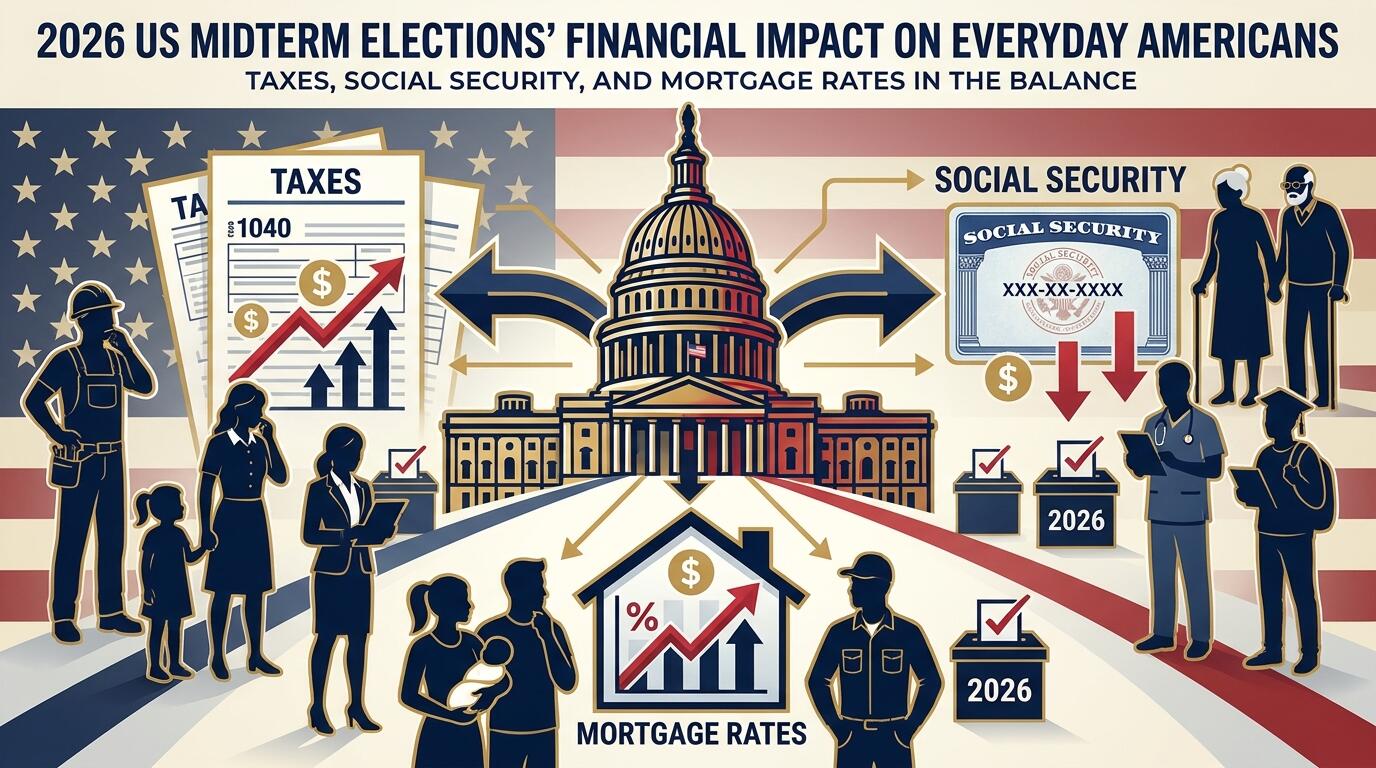
ALT: 2026 midterm elections impact on taxes Social Security and mortgage rates for everyday Americans
What the 2026 Midterms Could Mean for Your Wallet — and Why It Matters Now
The most pressing question heading into the 2026 midterm election cycle is straightforward: if control of Congress changes hands, what actually happens to your tax bill, your Social Security check, and the interest rate on your mortgage? The honest answer is that the outcome of the midterms could shift fiscal and monetary policy in ways that touch every corner of your personal finances — and understanding the mechanics now, before the votes are cast, gives you the clearest possible picture of what to watch for.
This guide is for anyone who wants to cut through the political noise and understand, in plain English, how a midterm election translates into real financial consequences. Whether you're a young professional filing your first federal return, a parent watching your 401(k), or simply someone trying to figure out whether now is a good time to lock in a mortgage rate, this breakdown is built for you.
Before You Start: What You Should Know About Midterms and Money
Most people are familiar with presidential elections, but midterm elections — which occur in the even-numbered year halfway through a presidential term — often receive less attention. That is a mistake, at least from a financial standpoint. Midterm elections determine which party controls the House of Representatives and, often, the Senate. Congressional control is critical because Congress writes tax law, sets spending levels for programs like Social Security, and influences the broader fiscal environment that shapes interest rates.
To follow this guide effectively, it helps to have a basic grounding in a few concepts.
What Congress actually controls. The U.S. Congress has the power of the purse. Tax legislation must pass through Congress, and major spending programs — including Social Security — are funded and structured through congressional action. The President can propose budgets and sign or veto legislation, but Congress holds the ultimate authority over the rules that govern your tax return and the solvency of federal benefit programs.
What the Federal Reserve controls — and what it doesn't. The Federal Reserve (commonly called "the Fed") is the central bank of the United States. It sets the federal funds rate, which is the interest rate banks charge each other for overnight loans. That rate ripples outward into mortgage rates, car loan rates, and savings account yields. Importantly, the Fed operates independently from Congress and the White House — it is not directly controlled by election outcomes. However, the fiscal policies that Congress enacts (like how much the government borrows and spends) create the economic backdrop the Fed responds to.
The difference between legislation and reality. Not every policy promise made during a campaign becomes law. A party that wins a slim majority in the House does not automatically get everything it wants — Senate rules, presidential vetoes, and internal party disagreements all act as friction. This guide explains the realistic policy scenarios, not worst-case or best-case predictions.
Before proceeding, make sure you understand these starting points:
The 2026 midterms will determine the composition of the full House of Representatives and roughly one-third of the Senate.
The sitting President's party historically tends to lose seats in midterm elections, though this is a pattern, not a guarantee.
Tax law changes require legislation — they do not happen automatically because one party wins an election.
Social Security is governed by a specific statute and cannot be altered unilaterally; changes require an act of Congress.
Mortgage rates are set by market forces and Fed policy, not directly by Congress, but fiscal policy creates real pressure on rates.
ALT: Diagram showing how 2026 midterm election outcomes flow through congressional policy into taxes Social Security and mortgage rate changes for American households
Step 1: Understand the Tax Landscape Heading Into 2026
The single most consequential tax issue tied to the 2026 midterms is the expiration of major provisions from the Tax Cuts and Jobs Act of 2017 (TCJA). The TCJA, passed by a Republican-controlled Congress and signed into law in December 2017, temporarily lowered individual income tax rates, roughly doubled the standard deduction, capped the deduction for state and local taxes (commonly called the SALT deduction), and expanded the child tax credit. Most of those individual provisions were written to expire — or "sunset" — at the end of 2025, meaning that without new legislation, the tax code would revert to its pre-2017 structure starting in 2026.
Congress has been debating whether to extend, modify, or allow those provisions to expire. The outcome of that debate — and the composition of Congress after the 2026 midterms — will determine which rules apply when Americans file their taxes in 2027 and beyond.
What a Republican-controlled Congress is more likely to pursue: Full extension or permanence of the TCJA individual rate cuts, keeping the standard deduction at its current elevated level, and potentially adjusting the SALT cap. The political incentive is to avoid the perception of a tax increase on middle-class families.
What a Democratic-controlled Congress is more likely to pursue: Allowing the TCJA rate cuts to expire for higher earners while preserving or expanding benefits for lower- and middle-income households, increasing the child tax credit, and potentially introducing new minimum taxes on wealthy individuals and corporations. The political framing would be tax fairness rather than broad-based cuts.
Tip: The most immediate impact on most households is the standard deduction. If the TCJA provisions lapse without replacement, the standard deduction drops significantly for a single filer and for married couples filing jointly — meaning more Americans would need to itemize deductions to avoid paying more. Watch this provision closely.
Step 2: Trace How Midterm Results Could Affect Social Security
Social Security is a federal program that provides retirement, disability, and survivor benefits to eligible Americans, funded through payroll taxes. The Social Security Administration (SSA) projects, based on its most recent trustees report, that the program's combined trust funds could be depleted within roughly the next decade if Congress takes no action — at which point incoming payroll tax revenue alone would cover only a portion of scheduled benefits.
The 2026 midterms matter here because any legislative fix — whether it involves raising the payroll tax cap, adjusting benefits, gradually increasing the retirement age, or some combination — requires Congress to act. And the direction of that fix depends heavily on which party holds the majority.
Republican-leaning approaches have historically favored structural reforms such as gradually raising the full retirement age to reflect longer life expectancy, or introducing means-testing so that higher-income retirees receive reduced benefits. These approaches aim to slow the growth of spending without raising taxes.
Democratic-leaning approaches have typically focused on increasing revenue by raising or eliminating the cap on earnings subject to the Social Security payroll tax (currently set by statute each year and adjusted for inflation). Some proposals also include benefit expansions for low-income seniors and surviving spouses.
What this means practically: If you are decades away from retirement, the composition of Congress after 2026 will likely influence whether you receive your full projected benefit, a reduced benefit, or a benefit calculated under a revised formula. If you are already receiving Social Security, near-term benefit cuts are politically very unlikely regardless of who wins — but longer-term sustainability questions remain real.
Tip: The Social Security Administration publishes an annual trustees report that lays out the program's long-range financial projections in clear terms. It is one of the most useful documents for understanding where the program stands without political spin.
Step 3: Connect Congressional Fiscal Policy to Mortgage Rates
Mortgage rates are not set by Congress, but Congress's decisions about spending and borrowing create powerful pressure on rates. Here is the chain of logic: when the federal government spends more than it collects in taxes, it borrows by issuing Treasury bonds. More borrowing means more supply of bonds in the market. Investors demand higher yields (interest payments) to absorb that supply. Because mortgage-backed securities are priced relative to U.S. Treasury yields, a rise in Treasury yields tends to push mortgage rates higher.
The 2026 midterms could affect this chain in two meaningful ways.
First, through federal spending decisions. If the incoming Congress extends all TCJA tax cuts without offsetting revenue or spending reductions, the Congressional Budget Office (CBO) — the nonpartisan agency that estimates the fiscal impact of legislation — has projected that this would add substantially to the federal deficit over the following decade. A larger deficit means more Treasury issuance, which can push yields and mortgage rates up, all else equal.
Second, through the signal Congress sends to bond markets. Financial markets price in expectations. If investors believe Congress is on a path toward larger deficits, they may demand higher yields on long-term Treasuries before Congress even passes any legislation. That "expectation effect" can move mortgage rates in the months surrounding a major election, even before any new law is signed.
What this means practically: A scenario in which the 2026 midterms produce a Congress that extends tax cuts broadly without addressing the deficit could put upward pressure on the 30-year fixed mortgage rate. Conversely, a Congress that takes steps toward deficit reduction — through some combination of revenue increases and spending changes — could help ease that pressure over time.
Tip: Watch the 10-year U.S. Treasury yield as a practical proxy for where mortgage rates are heading. It is publicly reported every trading day and moves in near real time as fiscal and monetary expectations shift.
Step 4: Factor In the Fed's Independent Role
The Federal Reserve is an independent institution — its policy decisions on interest rates are made by its Board of Governors and the Federal Open Market Committee (FOMC), not by elected officials. Congress created the Fed and could theoretically restructure it through legislation, but in practice the Fed's operational independence is a long-standing and deeply embedded feature of U.S. economic policy.
That said, the interaction between fiscal policy (controlled by Congress) and monetary policy (controlled by the Fed) is real and significant. In a pattern that analysts at the Fed have documented, if Congress passes large stimulus or deficit-expanding legislation during a period of already-elevated inflation, the Fed may feel compelled to keep interest rates higher for longer to prevent inflation from re-accelerating. That directly affects mortgage rates, car loan rates, and the cost of business borrowing.
Tip: The Fed's post-meeting statements and the minutes of FOMC meetings are publicly released on the Federal Reserve's website. Reading even the summary of these documents gives you a clear, unmediated view of how Fed officials are thinking about the economy — without the political interpretation layer added by news commentary.
Step 5: Map the Timeline from Election to Policy Impact
Congressional elections happen in November 2026. The new Congress is sworn in during January 2027. Major legislation — tax bills in particular — rarely passes in the first weeks of a new Congress; they typically require months of committee work, floor debate, and negotiation. This means:
Tax changes resulting from the 2026 midterms would most likely affect returns filed in 2028 (for tax year 2027), unless Congress acts retroactively or on an expedited basis.
Social Security reforms, if they move at all, tend to be phased in over years or decades to allow workers and retirees to adjust.
Mortgage rate effects from fiscal policy tend to be felt faster — markets reprice in anticipation, so the impact on rates could arrive well before any legislation is signed.
Tip: The period between an election and the swearing-in of a new Congress (sometimes called the "lame-duck session") can be surprisingly consequential. Legislation that was stuck in the prior Congress can sometimes advance quickly during this window if political incentives align.
Step 6: Identify What You Can and Cannot Control
Understanding the policy environment is useful precisely because it helps you separate what is in your control from what is not. You cannot control the election outcome or the direction of fiscal policy. What you can control: the timing and structure of financial decisions that are sensitive to interest rates and tax rules.
For mortgage decisions, understanding the rough direction of rate pressure — even qualitatively — helps you think about whether to lock a rate now versus waiting. For tax planning, knowing that the standard deduction might change in 2026 or 2027 is useful input for conversations with a tax professional. For Social Security, understanding the range of possible reforms helps you run realistic retirement scenarios rather than assuming your projected benefit is guaranteed.
Tip: None of this is investment advice or tax advice — it is financial literacy. A licensed tax professional or a fee-only financial planner can translate these macro scenarios into specific guidance for your situation.
Common Mistakes and Troubleshooting When Reading Election-Economy Coverage
Symptom — Likely Cause — How to Fix
Assuming election results immediately change your tax bill — Conflating election outcomes with enacted legislation — Remember: legislation must be passed by Congress and signed by the President before any tax rule changes. Track the legislative calendar, not just election night results.
Treating campaign promises as policy certainty — Media coverage that blurs the line between proposal and law — Cross-reference campaign promises against what Congress actually has the votes to pass. The CBO's cost estimates for specific bills are a useful reality check.
Believing the Fed will lower mortgage rates after a specific election — Misunderstanding the Fed's independence — The Fed sets policy based on inflation and employment data, not electoral outcomes. Monitor Fed communications directly rather than political commentary about what the Fed "should" do.
Assuming Social Security will be cut dramatically and immediately — Catastrophizing based on long-term projections — Even in a trust-fund-depletion scenario, incoming payroll taxes continue to fund a significant share of benefits. Near-term dramatic cuts are politically and structurally unlikely.
Ignoring bond market signals until after legislation passes — Waiting for certainty that never comes in fast-moving markets — Track the 10-year Treasury yield regularly as an early indicator of where mortgage rates are likely to move, ahead of any formal policy change.
Pro Tips for Following the 2026 Midterm-Finance Story
Read primary sources, not just headlines. The Congressional Budget Office publishes nonpartisan fiscal analyses of legislation, and the Social Security trustees publish annual projections. These documents are publicly available and written to be understood by a non-specialist audience. They are far more reliable than summary-of-summary news coverage.
Separate the electoral cycle from the economic cycle. Financial conditions — inflation, employment, consumer spending — evolve on their own schedule, independent of election calendars. A pattern that analysts consistently observe is that election-year volatility in markets is often overstated relative to what fundamentals actually justify. Be skeptical of narratives that tie every market move to a political event.
Understand the SALT deduction debate if you own property in a high-tax state. The cap on the state and local tax deduction introduced by the TCJA is one of the most geographically uneven provisions in the current tax code. Homeowners in states with high property and income taxes — such as California, New York, and New Jersey — face a very different set of incentives depending on whether the cap is maintained, raised, or eliminated. This is one area where your home state genuinely shapes how the federal tax debate affects your specific situation.
Do not conflate "debt ceiling" with "deficit." The debt ceiling is the legal limit on how much the federal government can borrow; the deficit is the gap between annual spending and revenue. Congress can vote to raise the debt ceiling without reducing the deficit — and frequently does. These are related but distinct concepts, and confusing them leads to misreading fiscal news.
A common misconception to dispel: Many people believe that if their preferred party wins the midterms, their taxes will automatically go down (or that the other party will automatically raise them). In practice, tax law is complex, changes are phased in, and the actual impact on any individual household depends on income level, filing status, deductions, and dozens of other variables. A midterm win is the beginning of a legislative process, not the end of one.
Q1: How do midterm elections affect federal tax rates for ordinary workers?
Midterm elections determine which party controls Congress, and Congress is the body that writes and passes tax legislation. If the 2026 midterms shift the House or Senate majority, the resulting Congress will have different priorities for extending, modifying, or replacing provisions of the Tax Cuts and Jobs Act of 2017 that are currently scheduled to expire. The impact on an individual worker depends on income level, filing status, and which specific provisions change — making it essential to follow the legislative process rather than election results alone.
Q2: Is Social Security at risk depending on the 2026 midterm outcome?
Social Security's long-term funding gap is a real, documented issue acknowledged in the program's own trustees reports. Whether and how Congress addresses it — through benefit adjustments, payroll tax changes, or other mechanisms — depends significantly on the ideological makeup of Congress after 2026. Near-term benefit cuts are highly unlikely politically regardless of the outcome, but the structure of the program over a decade or more will be shaped by the legislative choices the next Congress makes or declines to make.
Q3: How long does it take for midterm election results to affect mortgage rates?
Bond markets begin repricing based on expected fiscal policy as soon as election outcomes become clear — sometimes within days. Mortgage rates, which track closely with the 10-year U.S. Treasury yield, can shift in anticipation of policy changes before any legislation is passed. Actual legislative changes to fiscal policy that structurally affect rates typically take longer, often many months to years. Monitoring the 10-year Treasury yield is the most practical real-time indicator available to ordinary consumers.
Summary
The 2026 midterm elections are a pivotal moment for U.S. fiscal policy, with direct and traceable consequences for federal tax rules, the long-term structure of Social Security, and the interest rate environment that shapes mortgage costs.
The expiration of Tax Cuts and Jobs Act provisions at the end of 2025 means the next Congress will face immediate decisions about individual tax rates, the standard deduction, and the SALT cap — decisions that directly affect most American households.
Social Security's long-term funding gap is real and documented, and the direction of any legislative fix will reflect the priorities of whichever party controls Congress after 2026.
Mortgage rates are driven by market forces and Federal Reserve policy, but the fiscal decisions Congress makes — especially about deficits and borrowing — create meaningful upward or downward pressure on the 10-year Treasury yield that feeds into mortgage pricing.
The Federal Reserve operates independently of Congress, but fiscal policy and monetary policy interact in ways that affect the cost of borrowing for ordinary Americans.
There is a meaningful lag between an election, the passage of legislation, and the practical effect on your finances — but bond markets move on expectations, meaning some rate impact may arrive well before any law is signed.
The most useful next step is to follow these stories using primary sources: the CBO for fiscal analysis, the Social Security Administration's trustees reports for program solvency projections, and the Federal Reserve's public communications for the monetary policy picture.
Want to make sense of today's financial headlines without the jargon? Vega Brief breaks down complex economic, market, and personal finance news into clear, plain-English stories backed by real sources and free from investment advice — explore the latest explainers and start reading the news with confidence.
Sources & Further Reading
Congressional Budget Office. "The Budget and Economic Outlook."
https://www.cbo.gov
Social Security Administration. "The Annual Report of the Board of Trustees of the Federal Old-Age and Survivors Insurance and Federal Disability Insurance Trust Funds."
https://www.ssa.gov
Federal Reserve. "Federal Open Market Committee: Statements, Minutes, and Projections."
https://www.federalreserve.gov
Note: Legislation, program rules, and economic projections change frequently. Always consult the most current official documents or a qualified professional advisor for guidance specific to your situation.
For educational purposes only. Not investment advice. We do not recommend any stock, fund, broker or trading platform. Headlines are sourced from Google News · Business; every story links to the original publishers.