Understanding the Link Between National Deficits and Your Taxes
ALT: National deficit concept showing tax forms, government spending charts, and household budget impact
For educational purposes only. Not investment advice.
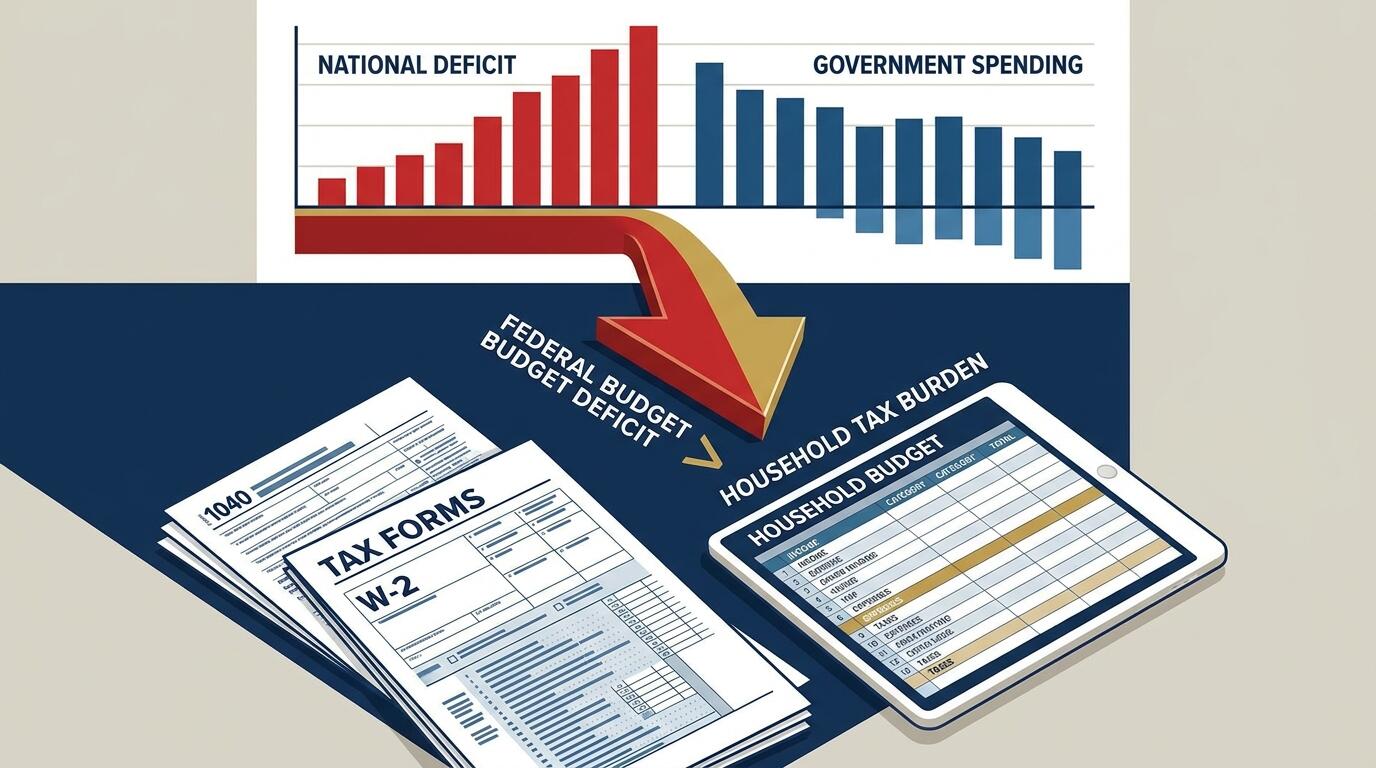
ALT: National deficit concept showing tax forms, government spending charts, and household budget impact
Why What Washington Spends Eventually Lands on Your Doorstep
You file your taxes each spring, grumble about the amount you owe, and move on. Meanwhile, news anchors debate trillion-dollar deficits as though they belong in a separate universe — one populated only by economists and senators. But the connection between what the federal government spends beyond its means and what you eventually pay is real, mechanical, and worth understanding. The central argument of this article is straightforward: national deficits — situations in which the government spends more than it collects — do not stay neatly inside Washington's ledgers. Over time, they reshape interest rates, crowd out public services, and put upward pressure on the taxes ordinary people pay.
This topic deserves a closer look right now because government borrowing in many advanced economies has reached levels that prompt serious debate among policymakers, economists, and households alike. At Vega Brief, a pattern we consistently see in our work is that people feel confused and vaguely anxious about deficit headlines without having a clear mental model for how those headlines connect to their own financial lives. This article builds that model, piece by piece, in plain English.
The State of Government Borrowing: How Deficits Became the Norm
A budget deficit is the gap that appears when a government spends more in a given year than it receives in tax revenue and other income. That gap must be financed somehow, and the standard tool is borrowing — typically by issuing government bonds, which are promises to repay investors with interest over time. Each year's deficit adds to the national debt, which is the running total of everything the government still owes from all prior borrowing.
For much of the twentieth century, large peacetime deficits were considered unusual. Governments borrowed heavily during wars or deep recessions, then aimed to pay down debt during good times. That discipline eroded gradually over recent decades. A combination of rising entitlement costs (programs like Social Security and Medicare that automatically grow as populations age), recurring tax cuts, and emergency spending during crises — financial collapses, pandemics — has made persistent deficits the new baseline in the United States and many peer countries.
The International Monetary Fund, a body that monitors the fiscal health of its 190 member nations, has repeatedly flagged the trajectory of government borrowing as a structural concern rather than a short-term blip. According to Harvard Kennedy School's public finance research, the national debt represents a genuine risk to long-term fiscal stability, particularly because a growing share of the federal budget must be devoted to interest payments — money that funds nothing in the present but services past obligations.
Understanding how this situation developed matters because the mechanisms that connect deficits to your personal finances have been building for years, not springing up overnight. The longer deficits persist, the deeper those channels run — and the more likely they are to affect ordinary households in tangible ways.
How Deficits Actually Reach Your Wallet: The Mechanics Explained
The relationship between government deficits and personal taxes is not a single straight line — it is a web of interconnected economic effects. Breaking it down into distinct mechanisms makes the picture much clearer.
The Direct Tax-Hike Route
The most obvious connection is also the most intuitive: if a government consistently spends more than it earns, it eventually has to raise revenue to close the gap. Tax increases are one of the primary tools available. Income taxes, payroll taxes, capital gains taxes, and consumption taxes like sales levies have all been raised at various points in history specifically to address mounting debt burdens. Historically, periods of elevated national debt have frequently been followed by legislative efforts to increase the tax base, broaden the range of taxable activities, or reduce deductions that effectively lower tax liability.
This is not an abstract risk. It is a pattern economists and fiscal historians have documented repeatedly across different countries and political systems. The specifics of how and when taxes rise vary enormously by political context, but the underlying pressure is consistent: debt service costs money, and that money has to come from somewhere.
The Interest Rate Squeeze
A less visible but equally important mechanism runs through interest rates. When the government borrows heavily, it competes with private borrowers — businesses seeking loans to expand, homebuyers seeking mortgages — for the same pool of available savings and investment capital. This competition tends to push interest rates higher, a phenomenon economists call crowding out.
Higher interest rates do not just affect government budgets. They translate directly into higher mortgage rates, higher auto loan rates, higher credit card rates, and higher student loan rates. Households feel the cost of government borrowing every time they apply for credit. For a deeper look at how interest rate movements ripple into everyday borrowing costs, the analysis of how the Federal Reserve's rate decisions affect your mortgage and savings provides useful context on the transmission mechanisms at work.
Inflation as a Hidden Tax
Governments facing large debt loads sometimes resort — deliberately or by circumstance — to allowing inflation to run higher than it otherwise would. Inflation is a general rise in the price level across an economy. When inflation is elevated, the real value of outstanding debt erodes, which benefits the borrower (the government) at the cost of everyone holding fixed-income assets or earning wages that do not keep pace.
Economists sometimes describe this dynamic as an inflation tax — a reduction in real purchasing power that effectively redistributes wealth from savers and wage earners toward the government without requiring any formal legislation. It is subtle, often invisible in any single month, but compounding over years it can meaningfully reduce household wealth.
Cuts to Public Services and Benefits
A fourth channel operates through spending reduction rather than revenue increase. When debt service consumes an ever-larger share of the federal budget, less money is available for everything else: infrastructure, education subsidies, research grants, and income support programs. For households that depend on these services — whether that means a student relying on federally backed loans, a family using public transit, or an older adult counting on Medicare's long-term solvency — the fiscal squeeze translates into reduced benefits or higher out-of-pocket costs, which are functionally similar to a tax increase.
The Long Lag That Creates False Comfort
One reason people underestimate the deficit-to-taxes link is timing. The consequences of today's borrowing often materialize years or even decades later. A deficit run in one political era can produce tax increases or spending cuts in a completely different one. This lag creates a kind of false comfort — the bill does not arrive the same month the spending occurs, so it is easy to treat the two as unconnected. But the debt accumulates steadily in the background, and eventually the accounting must balance.
Evidence and Competing Views: What the Data Shows
Economists do not speak with one voice on every aspect of this relationship, and intellectual honesty requires acknowledging the debate. The evidence, broadly, supports the link between sustained deficits and eventual fiscal pressure on households — but the timing, magnitude, and distribution of that pressure are genuinely contested.
Research by Harvard Kennedy School's public finance scholars underscores the risk of a fiscal crisis as debt-to-GDP ratios climb — a situation in which market confidence in a government's ability to repay could erode quickly, forcing abrupt and painful adjustments. AP Macroeconomics educational resources, drawing on foundational economic theory, similarly document how deficits add to national debt in ways that compound over time and constrain future policy choices.
The IMF's recent warnings about budget deficits not seen since the COVID era reflect a growing consensus among international fiscal observers that the current trajectory of government borrowing in major economies is not self-correcting and requires deliberate policy responses.
At the same time, a minority of economists — often associated with Modern Monetary Theory (MMT) — argue that for governments that issue their own currency, the constraints imposed by deficits are more flexible than conventional analysis suggests. Under this view, a currency-issuing government can always meet nominal debt obligations and need not raise taxes purely to reduce debt. Critics of MMT counter that while default risk may be lower for currency issuers, the inflation consequences of unconstrained borrowing are real and represent a meaningful cost to households.
The comparison table below captures the core tension:
Perspective / Approach — Strengths — Trade-offs — Best Fit
Conventional fiscal view — Grounded in historical evidence; highlights compounding debt risks — May overstate near-term crisis probability for large economies — Understanding long-run tax and interest rate pressure
Keynesian demand management — Supports deficit spending during recessions as stabilizing — Requires discipline to reduce deficits in good times — often lacking — Short-term economic downturns and unemployment crises
Modern Monetary Theory — Challenges simplistic "government as household" analogies — Underweights inflation risk; limited real-world track record at scale — Theoretical exploration; contested in mainstream policy
Structural reform approach — Targets root causes (entitlement growth, tax base erosion) — Politically difficult; distributional effects can be regressive — Long-term debt sustainability planning
The weight of evidence in mainstream economics and fiscal policy research supports the view that sustained, large deficits — the kind that persist across economic cycles — do eventually translate into higher taxes, higher interest rates, or reduced public services. The debate is primarily about how quickly, in what form, and who bears the burden most heavily.
Where This Is Heading — and What It Means for You
The outlook for government borrowing in the United States and many comparable economies is one of continued upward pressure on debt levels. Aging populations mean that the costs of retirement and health programs will mechanically grow faster than the tax base in the near term, barring significant policy changes. Interest payments on existing debt are already consuming a larger fraction of federal budgets than in recent memory, leaving less room for discretionary choices.
For everyday households, this trajectory carries several practical implications:
Tax policy uncertainty is likely to remain elevated. The political debate over whether to raise rates, eliminate deductions, expand taxable income categories, or cut spending programs is likely to intensify as fiscal pressures mount. Planning personal finances with some awareness of this uncertainty — rather than assuming current tax rates are permanent — is prudent.
Interest rate levels are likely to remain structurally higher than the ultra-low environment that characterized the decade after the 2008 financial crisis, in part because elevated government borrowing competes for capital. This has direct consequences for anyone carrying variable-rate debt or planning a major borrowing decision.
The value of financial literacy is not abstract. Understanding what deficit headlines actually mean for your borrowing costs, your tax situation, and the services you depend on gives you a meaningful advantage in making decisions — from how aggressively to pay down debt, to how to think about long-term savings.
The single most accessible action for most readers is to stay informed in a way that is genuinely educational rather than alarmist or politically charged. Reading explainers that connect the macro news to household-level effects — rather than screaming headlines — builds the kind of mental model that supports good decisions over time.
ALT: Visual showing the chain from national budget deficit to government bonds, rising interest rates, and household tax burden
Q1: How does a national deficit directly affect the taxes I pay today?
A national deficit does not automatically trigger an immediate tax increase — the connection usually operates with a lag. In the short run, deficits are financed through government borrowing, so your current-year tax bill may not change at all. Over time, however, higher debt levels increase pressure on policymakers to raise revenue, reduce deductions, or allow inflation to erode purchasing power. The Congressional Budget Office and similar fiscal bodies model these pressures regularly as part of long-term budget outlooks.
Q2: Are all government deficits harmful to household finances?
Not all deficits carry the same risk. Deficits incurred during recessions — when tax revenues fall and emergency spending rises automatically — are widely considered stabilizing by mainstream economists. The concern arises with structural deficits: persistent gaps that exist even when the economy is healthy, driven by mismatches between spending commitments and the tax base. Structural deficits are the type most closely associated with long-term tax pressure and interest rate effects on households.
Q3: How long does it typically take for deficits to translate into higher taxes or reduced services?
The timeline varies considerably and depends on factors including the level of debt relative to GDP, market confidence, and political will to act. Historical episodes suggest lags of many years or even decades between sustained deficit accumulation and significant fiscal adjustment. However, interest rate effects — which show up in mortgage, auto, and credit card rates — can materialize more quickly as borrowing competes with the private sector for available capital. The lag creates complacency risk: by the time consequences are obvious, the adjustment required is often larger.
The Bottom Line
Three core points emerge from this analysis. First, national deficits and personal taxes are connected through several distinct channels — direct tax policy, interest rate effects, inflation, and reductions in public services — none of which operates immediately, but all of which are real and documented. Second, the current fiscal environment in major economies is characterized by persistently elevated borrowing that structural forces (aging populations, entitlement costs, debt service) are likely to sustain, making the deficit-to-household-impact link more relevant than it was in eras of lower debt. Third, understanding this link is genuinely useful for making better personal financial decisions, from how you think about debt repayment to how you anticipate future changes in your tax situation.
The actionable steps are not complicated: stay informed using sources that explain rather than alarm, factor interest rate and tax uncertainty into financial planning, and resist the temptation to treat current conditions as permanent simply because the consequences of borrowing take time to arrive.
Want to make sense of today's financial headlines without wading through jargon? Vega Brief breaks down complex economic, market, and personal finance news into clear, plain-English explainers — always educational, always source-linked, and never pushing a product or investment agenda. Visit Vega Brief to start reading the news the way it was meant to be understood.
References
Harvard Kennedy School. "Explainer: The national debt and the risk of a fiscal crisis".
https://www.hks.harvard.edu/faculty-research/policy-topics/public-finance/explainer-national-debt-and-risk-fiscal-crisis
Past Paper Hero. "Government Deficits and the National Debt".
https://www.pastpaperhero.com/resources/ap-macroeconomics-government-deficits-and-the-national-debt-deficits-add-to-national-debt
International Monetary Fund. "World Economic Outlook and Fiscal Monitor".
https://www.imf.org
For educational purposes only. Not investment advice. We do not recommend any stock, fund, broker or trading platform. Headlines are sourced from Google News · Business; every story links to the original publishers.