Why Mortgage Rates Near 7.4% Are Reshaping the 2026 Housing Market
ALT: Mortgage rates near 7.4% reshaping 2026 housing market affordability and buyer decisions
For educational purposes only. Not investment advice.
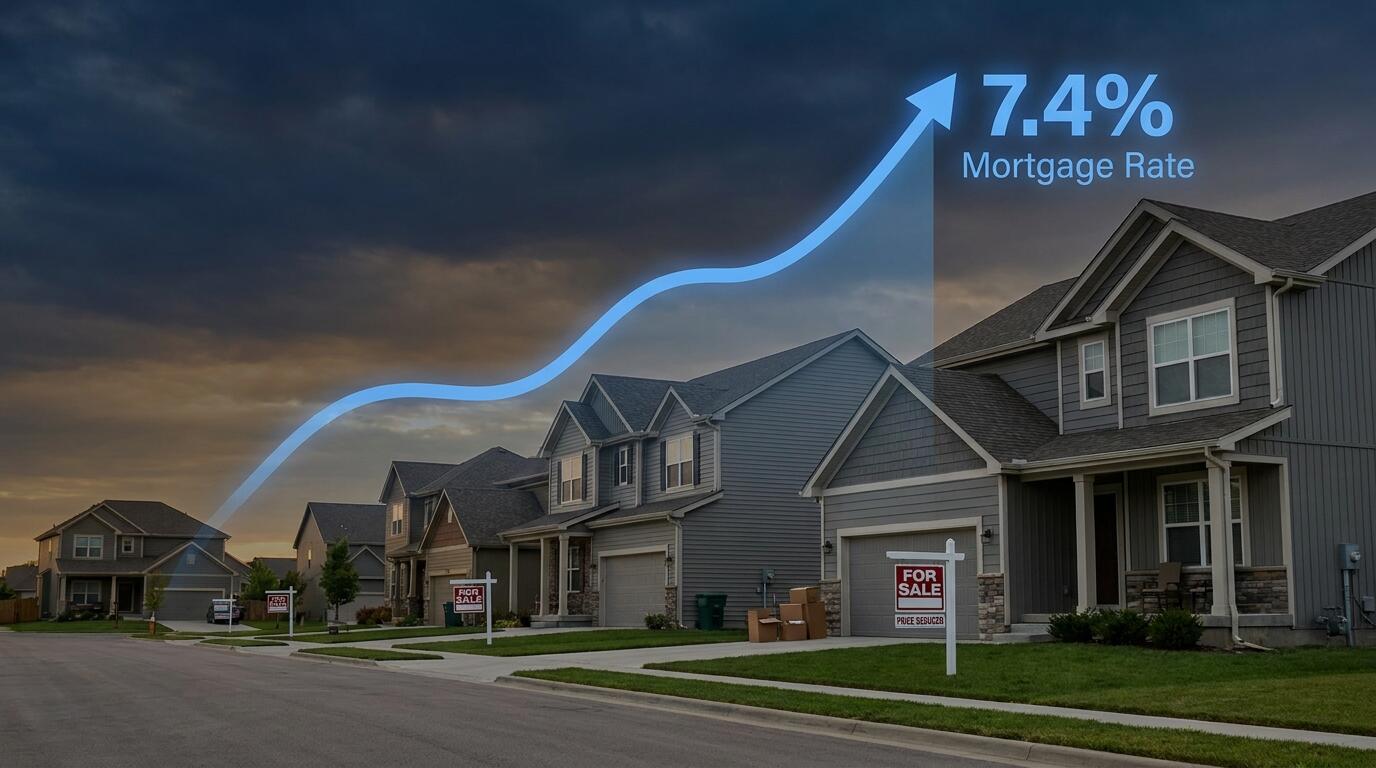
ALT: Mortgage rates near 7.4% reshaping 2026 housing market affordability and buyer decisions
What Mortgage Rates Near 7.4% Really Mean for the 2026 Housing Market
The single question on every would-be homebuyer's mind right now is this: with mortgage rates hovering near 7.4%, is the 2026 housing market genuinely shifting — or are we watching the same frustrating cycle play out again? The short answer, backed by a growing body of analyst commentary and economic data, is that rates at this level are not simply a temporary headache. They are actively reorganizing who buys, who sells, where people move, and what "affordable" even means anymore.
This topic demands a closer look precisely because the stakes have compounded. First-time buyers who spent 2022 and 2023 waiting for relief are now entering a market where waiting may no longer be a neutral act. Sellers who locked in 2–3% rates during the pandemic era are still reluctant to list, deepening a supply crunch that higher borrowing costs alone cannot fix. Understanding what is actually happening — and why — is the first step toward navigating this landscape with clear eyes.
How the 2026 Housing Market Got Here: Background and Current Landscape
The U.S. housing market arrived at its current state through a sequence of events that began well before 2026 — and understanding that sequence is essential to making sense of today's conditions. In 2020 and 2021, the Federal Reserve slashed benchmark interest rates to near zero to cushion the economy from the pandemic's blow. Mortgage rates followed, briefly dipping below 3%, unleashing a buying frenzy that pushed home prices to historic highs across nearly every metro area.
Then came the correction. Beginning in early 2022, the Fed launched one of the most aggressive rate-hiking campaigns in decades to combat inflation that had surged to multi-decade highs. The 30-year fixed-rate mortgage — the most common home loan in the United States — climbed from sub-3% to above 7% within roughly 18 months, a pace of increase that caught many buyers and sellers completely off guard.
By 2025, rates had stabilized at elevated levels rather than retreating significantly. Analysts who had expected rates to fall toward 5–6% as inflation cooled found their forecasts repeatedly pushed back. According to reporting aggregated by Yahoo Finance, mortgage rates could dip somewhat in 2026 but are unlikely to fall sharply, with many projections still clustering around the 6–7% range rather than delivering the relief buyers were hoping for. A separate analysis from eHomesurf summarizing expert forecasts suggested that 6% may become a "new normal" — a ceiling-level expectation rather than an optimistic floor.
This means that the era of sub-4% mortgages, which once felt temporary but now looks permanently closed, has fundamentally reset the affordability calculus for an entire generation of buyers. A buyer who could have purchased a $400,000 home with a monthly payment of roughly $1,700 at a 3% rate now faces a payment closer to $2,750 at 7.4% — an increase of more than $1,000 per month on the same home, before accounting for higher home prices themselves.
ALT: Graph showing 2026 housing market trends, elevated mortgage rates near 7.4%, and reduced buyer affordability in U.S. real estate
The inventory problem compounds this affordability squeeze. Many existing homeowners who refinanced at historically low rates during 2020–2021 face a powerful financial disincentive to sell — a phenomenon economists call the rate lock-in effect. Selling means giving up a 2.5% mortgage and taking on a new one at 7.4%, which can translate to hundreds of dollars more per month even when downsizing. The result: fewer homes are coming to market, which keeps prices elevated despite weakened demand from buyers who simply cannot stretch their budgets any further.
The Underlying Drivers: Why Rates Are Staying High and What That Triggers
Mortgage rates near 7.4% are not a random number — they are the product of specific, identifiable forces that interact in predictable ways, even if the exact timing of their resolution remains uncertain.
The Federal Reserve's Inflation Mandate
The Federal Reserve is the U.S. central bank tasked with maintaining price stability and maximum employment. Mortgage rates do not move in lockstep with the Fed's benchmark interest rate, but they are closely tied to the yield on 10-year U.S. Treasury bonds, which itself responds to market expectations about where the Fed's policy is headed. When inflation remains above the Fed's 2% target — as it has for an extended stretch — investors demand higher yields on longer-dated bonds to compensate for the risk that their future returns will be eroded by rising prices. Higher Treasury yields pull mortgage rates upward with them.
In our analysis of how financial news translates into real-world outcomes, a pattern that consistently emerges is that general readers underestimate this transmission mechanism. Many assume the Fed directly "sets" mortgage rates, but the chain of causation is more indirect — and more vulnerable to surprises from jobs data, consumer spending reports, or geopolitical events that shift bond market sentiment overnight.
The Mortgage Spread Problem
Beyond Treasury yields, a mortgage spread — the gap between the 30-year fixed mortgage rate and the 10-year Treasury yield — has widened considerably compared to historical norms. This spread captures the additional risk premium that mortgage lenders and bond investors demand over and above the "safe" government bond yield. When the spread is wider than usual, as it has been in recent years, mortgage rates end up higher than Treasury yields alone would predict.
Several factors contribute to a wider spread in the current environment: uncertainty about the pace of mortgage prepayments (which accelerate when rates fall, reducing investor returns), reduced appetite among certain institutional buyers for mortgage-backed securities, and the general volatility premium baked in when the future path of rates is less certain. This spread dynamic is one reason rates have remained stubbornly elevated even during periods when Treasury yields briefly pulled back.
Housing Supply and the Rate Lock-In Effect
The rate lock-in effect is the reluctance of existing homeowners to sell and surrender their below-market mortgage rate. This is not merely a psychological quirk — it is a mathematically rational response to an extreme rate environment. With roughly a third or more of outstanding U.S. mortgages reportedly carrying rates below 4%, according to various housing market researchers, the financial penalty for voluntarily giving up those loans is substantial. The consequence is a housing supply shortage that persists independently of demand conditions, keeping prices from falling in ways that might otherwise restore affordability.
This creates a particularly counterproductive cycle: high rates suppress demand, but they also suppress supply, which keeps prices elevated, which means the affordability problem does not correct itself even when demand softens. Buyers waiting for prices to drop may find that the supply-demand imbalance prevents the meaningful price correction they are anticipating.
Wage Growth, Inflation, and Purchasing Power
A third driver shaping the 2026 housing market is the relationship between wage growth and home prices. Wages in many sectors have grown since the pandemic, but in most U.S. markets, home prices have risen faster and for longer, producing a purchasing-power gap that is proving difficult to close. First-time buyers — typically younger, with shorter savings histories and fewer assets to leverage — are disproportionately affected. Trade-up buyers face a different version of the same problem: the equity they have built in their current home may feel substantial, but it does not fully compensate for the higher carrying cost of the next property at current rates.
Evidence and Multi-Angle Perspectives on the 7.4% Rate Environment
Analysts and market observers approach the 2026 housing market from notably different vantage points, and understanding the range of perspectives helps readers avoid anchoring too firmly on any single forecast.
Some economists argue that rates near 7.4% will gradually force a market reset — that prices in overheated markets must eventually soften because the pool of buyers who can qualify and afford current payments is simply too small to sustain prior price levels. Others contend that structural supply shortages are so deep, particularly in high-demand metropolitan areas, that prices will remain sticky even as volume (the number of homes actually changing hands) continues to decline.
A third viewpoint, represented in YouTube housing market commentary aggregated by research platforms, holds that 2026 could begin to look like a "rebound year" — not because rates will drop sharply, but because buyers who have been waiting on the sidelines will eventually capitulate and re-enter the market, driven by life events (job changes, family growth, relocations) that cannot be indefinitely deferred.
The table below summarizes these competing perspectives and their implications for different types of participants:
Perspective / Approach — Strengths — Trade-offs — Best Fit
Rates force a price correction — Grounded in affordability math; historically rates and prices have an inverse relationship — Supply shortage may prevent meaningful price drops in many markets — Buyers in markets with softer demand or newer construction inventory
Supply scarcity keeps prices elevated — Explains current price stickiness despite weak volume — Does not help buyers who need affordability relief now — Sellers considering whether to list; current homeowners tracking equity
2026 as a slow rebound year — Acknowledges pent-up demand and life-event-driven purchases — Rebound may be mild and uneven across regions — Buyers who have been waiting but face life circumstances requiring a decision
Rates stabilize near 6–7% as "new normal" — Consistent with expert consensus; avoids false hope of a return to sub-4% — Permanently reduces affordability relative to the 2020–2021 baseline — Long-term financial planners recalibrating homeownership timelines
A common mistake we see in how buyers interpret rate forecasts is treating "rates could fall to 6%" as a near-term certainty rather than a range-bound probability. A drop from 7.4% to 6% would reduce monthly payments meaningfully — but only if home prices do not rise commensurately in response to that improved affordability, which history suggests is not guaranteed.
Another risk worth naming plainly: buyers who stretch aggressively to qualify at current rates, counting on refinancing when rates fall, are making a bet on timing that may not pay off on the schedule they assume. Refinancing involves its own costs, and a rate decline that takes longer than expected can turn a "bridge" strategy into a prolonged financial strain.
Outlook and What It Means: Where the 2026 Housing Market Is Heading
The most honest summary of where the 2026 housing market is heading is this: conditions are improving at the margins, but the fundamental affordability challenge created by rates near 7.4% will not resolve quickly. Expert forecasts, including those surveyed by eHomesurf, suggest that a 6% rate environment — not a return to 3% — is the realistic best-case scenario for the near term. That represents progress, but it still leaves monthly payments dramatically higher than the 2020–2021 benchmark that shaped many buyers' mental models of what homeownership should cost.
Several implications flow from this outlook:
Buyers who have been waiting for a dramatic rate drop may need to recalibrate their expectations. The question is not whether rates will return to pandemic-era lows — most credible analysts say they will not — but whether the buyer's own financial situation (income, savings, job stability) is strong enough to support a purchase at today's costs.
Regional variation will matter enormously. Markets with strong new construction pipelines, employer relocations, or population inflows will behave differently from markets defined primarily by existing-home inventory. Generalizations about "the housing market" often obscure wide divergences between specific metros.
The rate lock-in effect will gradually erode, but slowly. As time passes, more homeowners will face life circumstances that require selling — divorce, job relocation, estate settlements — regardless of their mortgage rate. This slow release of inventory is one reason some analysts see modest improvement in supply over the 2025–2026 period, without anticipating a flood.
For renters deciding whether to buy, the rent-versus-own calculation has shifted significantly. In many markets, monthly rent for comparable space now approaches or exceeds what a mortgage payment would cost — but ownership still carries the added weight of a large down payment, closing costs, property taxes, and maintenance obligations. Understanding the full cost picture, rather than focusing solely on the monthly payment, is critical to making a sound decision.
For anyone looking to stay current on how these dynamics evolve, Vega Brief provides clear, plain-English breakdowns of the economic and housing news that most directly affects everyday financial decisions — without the jargon or the sales pitch.
Q1: How does a mortgage rate near 7.4% affect monthly payments compared to lower rates?
A 30-year fixed mortgage at 7.4% produces monthly payments that are dramatically higher than those at the sub-3% rates of 2020–2021. On a $350,000 loan, the difference can exceed $1,000 per month between a 2.75% rate and a 7.4% rate. This payment gap is what makes current affordability conditions so difficult, particularly for first-time buyers who cannot offset higher rates with equity from a prior home sale.
Q2: Are home prices expected to fall in 2026 as mortgage rates stay elevated?
Home prices are not broadly expected to fall sharply in 2026, despite high borrowing costs. The persistent rate lock-in effect — which discourages current homeowners with low-rate mortgages from selling — is limiting new inventory and preventing the kind of supply surge that typically drives price corrections. Price growth may slow or stall in some markets, but a nationwide price decline comparable to 2008 is not the consensus forecast among housing economists.
Q3: When might mortgage rates return to more affordable levels, and how long should buyers wait?
Most credible forecasters, including those surveyed by eHomesurf, suggest rates settling near 6% in 2026 represents a realistic near-term floor — not a return to the pandemic-era lows of 2–3%, which are widely considered an anomaly. Buyers banking on a return to those levels may face an indefinite wait. Life circumstances — job changes, family growth, lease expirations — often make the timing decision for buyers, regardless of where rates sit at any given moment.
Wrapping Up
The 2026 housing market is being shaped by a set of forces that are more durable and interconnected than many buyers, sellers, and observers initially expected. Three core points stand out from this analysis:
First, mortgage rates near 7.4% are not a temporary anomaly — they reflect a genuine reset in the cost of borrowing that is unlikely to fully unwind in the near term. The pandemic-era rate environment was the aberration; today's conditions, while painful, are closer to historical norms than the sub-3% world that shaped recent expectations.
Second, the supply shortage created by the rate lock-in effect is as important to understanding current market dynamics as the demand suppression caused by high rates. These two forces together explain why the market feels stuck — neither crashing nor recovering with the speed that either buyers or sellers would prefer.
Third, regional variation is significant. Broad headlines about "the housing market" routinely miss the fact that conditions in high-demand sunbelt metros, rust-belt cities, and coastal urban centers can diverge sharply from each other. Informed decision-making requires local context, not just national averages.
The most practical next step for anyone tracking this space is to stay consistently informed — not through headline-level alerts, but through substantive explanations that connect economic events to their real-world implications.
Want to make sense of today's financial headlines without the jargon? Visit Vega Brief to stay informed, one story at a time.
References & Further Reading
Yahoo Finance. "Mortgage rates could dip in 2026 but not by much."
https://finance.yahoo.com/news/mortgage-rates-could-dip-2026-224204554.html
eHomesurf. "2026 Mortgage Rate Forecast: Experts Predict a 6% 'New Normal.'"
https://ehomesurf.com/blog/the-new-normal-why-mortgage-rates-are-expected-to-landand-stickaround-6-in-2026
YouTube / Housing Market Analysis. "Why 2026 Looks Like the Real Estate Rebound Year We've Been Waiting For."
https://www.youtube.com/watch?v=7bYQXE7XFj4
Federal Reserve. Official monetary policy communications and economic research.
https://www.federalreserve.gov/
Note: Economic conditions and interest rate forecasts are subject to rapid change; always consult the most current official publications and speak with qualified financial or housing advisors before making major decisions.
For educational purposes only. Not investment advice. We do not recommend any stock, fund, broker or trading platform. Headlines are sourced from Google News · Business; every story links to the original publishers.