How Midterm Politics Are Shaping the Current Jobs Debate
ALT: Midterm election politics shaping the jobs debate and labor market policy in 2026
For educational purposes only. Not investment advice.
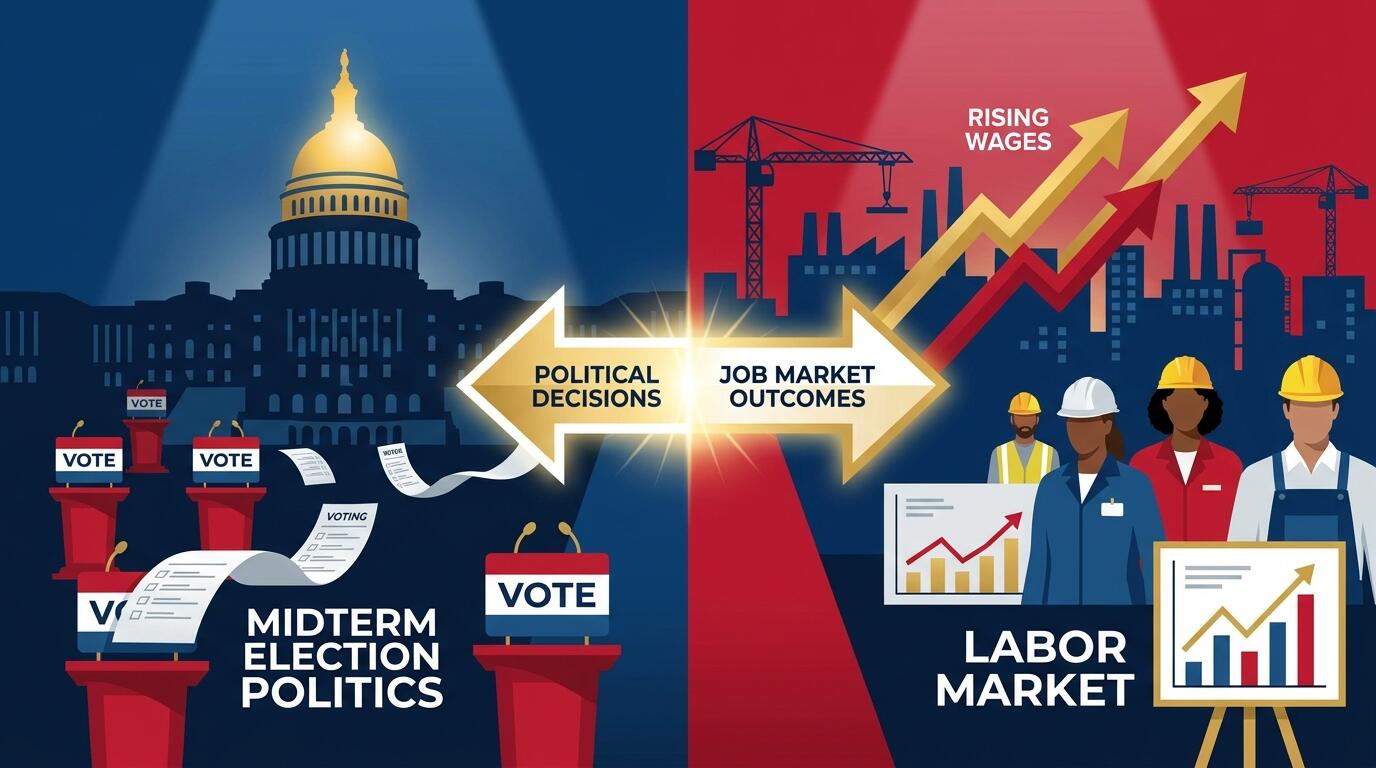
ALT: Midterm election politics shaping the jobs debate and labor market policy in 2026
What Every News Reader Should Understand About Politics and the Jobs Debate Right Now
The single question we hear most often at Vega Brief when economic headlines heat up around election cycles is this: Does who wins elections actually change what happens to jobs? The short answer is yes — but not always in the ways politicians claim, and rarely as quickly as campaign ads suggest. The relationship between midterm politics and the labor market is one of the most consequential and most misunderstood stories in financial news today.
This guide breaks down the key forces, arguments, and mechanisms that connect the political environment surrounding the 2026 midterms to the ongoing national debate over employment, wages, and economic security. We selected these items based on the patterns we consistently observe when translating complex economic and policy coverage into plain language: the factors that show up repeatedly in credible reporting, that have documented effects on labor markets, and that everyday readers most often misread or overlook. Use this list as a map — not a political endorsement — to help you understand what you're actually reading when jobs headlines collide with election coverage.
The Spending Power of a Divided or Unified Congress
Congressional composition — specifically whether one party controls both chambers or whether power is split — is one of the most direct political levers affecting labor market outcomes. A unified Congress can pass large-scale spending bills that create or destroy jobs relatively quickly through infrastructure investment, defense contracts, or social program funding. A divided Congress tends toward gridlock, which limits government's ability to act as an economic stimulus or brake.
In the period leading up to any midterm cycle, the current balance of congressional power shapes what policies are even possible. Employers in sectors sensitive to government contracts — construction, healthcare, defense, energy — watch congressional control closely because contract pipelines and regulatory environments shift measurably depending on which party holds the appropriations committees.
Best for: Readers trying to understand why certain industries' hiring outlooks are tied to political forecasting
Watch out: Congressional action often takes months or years to translate into actual job gains or losses. Political promises made during campaigns frequently face procedural and budgetary obstacles that slow or dilute their labor market impact.
The Role of Fiscal Policy Debates in Shaping Employer Confidence
Fiscal policy — the government's decisions about taxation and spending — directly influences how confident businesses feel about hiring. When midterm campaigns center on large tax changes, subsidy programs, or spending cuts, employers in affected industries often pause hiring decisions until they have more clarity about the regulatory and tax landscape they'll be operating in.
A pattern we consistently see in financial news coverage is that uncertainty itself acts as a drag on employment. Businesses rarely announce that they're delaying hiring because of an election, but economists who study labor market flows note that hiring and investment decisions slow when policy outcomes are genuinely unclear. The Brookings Institution has examined the pressures shaping the 2026 midterms and identified fiscal policy credibility as a central concern for both markets and voters.
Best for: Readers who want to understand why job reports might soften in election years even when the underlying economy is stable
Watch out: Employer confidence surveys can be influenced by partisan sentiment, not just objective economic conditions. A business owner who fears one party's policies may report lower hiring intentions regardless of actual demand for their products.
Minimum Wage and Labor Standard Proposals as Election Flashpoints
Minimum wage legislation is one of the most reliably polarizing labor policy issues in any midterm cycle. Candidates on both sides use it as a mobilizing signal — one side framing higher minimums as essential economic justice, the other framing them as a job-killer for small businesses. For everyday readers, the important thing to understand is that the empirical research on minimum wage effects is genuinely more nuanced than either campaign message.
Academic research — including work from institutions like the National Bureau of Economic Research — consistently shows that moderate minimum wage increases in strong labor markets tend to raise incomes for low-wage workers without causing significant job losses. However, large, rapid increases in weaker local economies can lead to reduced hours or slower hiring in certain sectors. The political debate tends to flatten this nuance into absolute claims that don't reflect the evidence.
Best for: Readers trying to cut through campaign rhetoric and understand what wage policy changes might actually mean for workers and small business owners in their area
Watch out: State and local minimum wage laws often diverge significantly from federal proposals. A national campaign promise about minimum wages may have limited practical impact if states have already moved independently.
Trade Policy Rhetoric and Its Effect on Manufacturing Jobs
Trade policy is a perennial midterm campaign topic, particularly in swing districts with significant manufacturing employment. Candidates frequently promise to protect or restore manufacturing jobs through tariffs, trade renegotiations, or domestic sourcing requirements. Understanding the gap between that rhetoric and actual labor market outcomes is essential for news readers trying to make sense of economic coverage.
Tariffs and trade restrictions can protect some jobs in targeted industries while simultaneously raising costs for other industries and consumers. The net employment effect is often contested among economists and depends heavily on the specific goods, trading partners, and timescales involved. What midterm politics adds to this equation is the incentive to make short-term, visible promises — announcing a plant reopening or a tariff on a specific product — even when the longer-term labor market math is more complicated.
Best for: Readers in manufacturing-heavy regions trying to evaluate what candidates' trade promises might realistically deliver
Watch out: Trade policy changes often take years to materially affect employment in specific sectors, and retaliatory measures by trading partners can offset domestic job gains. Headlines about new tariffs don't always translate into the job numbers promised.
The Debt Ceiling and Government Spending Limits as a Jobs Wildcard
Debt ceiling debates — which recur with predictable political drama — have real but often underappreciated effects on employment, particularly in sectors dependent on federal contracts and government employment. When the government approaches its borrowing limit and Congress fails to raise it promptly, federal agencies begin contingency planning that can include hiring freezes, contract delays, and reduced procurement.
The 2026 midterm environment puts particular pressure on fiscal negotiations because, as analysts have noted, the U.S. is carrying budget deficit levels that raise serious questions about long-term fiscal sustainability. The IMF has flagged concerns about budget deficits not seen since the Covid era, adding an international dimension to what might otherwise look like a purely domestic political standoff.
Best for: Readers who want to understand why seemingly abstract debates about government borrowing limits show up in economic forecasts and hiring outlooks
Watch out: Debt ceiling crises are frequently resolved at the last moment, but the uncertainty leading up to resolution can still cause measurable economic drag. The threat of a crisis has labor market effects even when the crisis is ultimately avoided.
Immigration Policy Debates and Labor Supply
Immigration policy is a defining midterm issue in many competitive districts, and it has direct, documentable effects on labor supply in specific industries. Agriculture, construction, hospitality, and healthcare all rely heavily on immigrant workers — both documented and undocumented — and changes to immigration enforcement, visa programs, or pathways to legal status directly affect labor availability in those sectors.
Campaigns that promise stricter immigration enforcement tend to create anxiety among employers in labor-intensive industries about whether they'll be able to maintain their workforce. Campaigns promising expanded work visa programs or more generous asylum policies have the opposite effect. The labor market reality is that many sectors facing persistent worker shortages have found it difficult to fill roles with domestic workers alone, regardless of wage levels — a fact that tends to complicate the simple political narratives on both sides.
Best for: Readers trying to understand why industries like agriculture or construction report labor shortages even when national unemployment figures look relatively healthy
Watch out: Immigration policy changes often face legal challenges and implementation delays that mean the actual labor market effect arrives much later, and sometimes in diminished form, compared to what was promised or threatened.
The Federal Reserve's Uneasy Position Alongside the Political Cycle
The Federal Reserve — the U.S. central bank — is legally independent of political control, but its decisions on interest rates intersect with the midterm jobs debate in ways that are genuinely significant. When the Fed raises interest rates to combat inflation, borrowing becomes more expensive, business investment slows, and hiring typically cools. Politicians up for election in a cooling job market have strong incentives to criticize the Fed, even though they have no authority over it.
Understanding how the Federal Reserve's rate decisions affect your mortgage and savings is essential context for reading any jobs-related political coverage. A candidate promising more jobs while simultaneously endorsing policies that would increase inflation — which would likely prompt the Fed to raise rates further — is presenting a contradiction that campaign coverage rarely unpacks clearly.
Best for: Readers trying to understand why politicians and central bankers are often saying opposite things about the same economy
Watch out: The Fed's stated mandate is price stability and maximum employment — not supporting any administration's political goals. Reading claims that politicians have somehow "forced" the Fed's hand usually requires significant skepticism.
Green Jobs and Energy Policy as a New Axis of the Employment Debate
Energy policy has become one of the sharpest dividing lines in midterm politics, and it carries significant labor market implications. The shift toward renewable energy — wind, solar, electric vehicles — is creating new categories of employment while disrupting established fossil fuel industries. The political debate frames this transition as either a jobs boom or a jobs catastrophe, depending on which industries your district is most invested in.
The truth, as is often the case in labor economics, is more geographically and temporally uneven than either campaign message allows. New energy jobs are being created, but they are often in different locations and require different skills than the jobs being displaced. For workers in traditional energy communities, the transition is a real economic disruption — not an abstract policy debate. For workers in regions attracting new energy investment, it may represent genuine opportunity. AI investment and broader technological shifts are adding another layer to this energy-and-jobs story, as automation affects both old and new energy sectors simultaneously.
Best for: Readers in energy-dependent regions trying to evaluate what competing candidates' energy policies might mean for local employment over a realistic time horizon
Watch out: Projections about future green jobs are frequently optimistic in political settings. The actual number and location of new jobs depends on policy implementation, private investment decisions, and global market conditions — none of which a single election controls entirely.
ALT: Comparison of midterm political forces shaping labor policy, hiring, wages, and employment in election year economy
A Quick Look at How These Forces Compare
Political Force — Best For Understanding — Key Strength as a News Lens — Key Limitation
Congressional composition — Industry hiring outlooks — Explains legislative possibility vs. gridlock — Effects often delayed by months or years
Fiscal policy debates — Business hiring pauses — Connects uncertainty to employer behavior — Partisan sentiment distorts surveys
Minimum wage proposals — Wage and income coverage — Grounded in substantial empirical research — National rhetoric often ignores local variation
Trade policy rhetoric — Manufacturing region jobs — Explains sector-specific promises — Net employment math is contested
Debt ceiling debates — Federal contractor hiring — Ties abstract politics to concrete job effects — Crises usually resolved, but uncertainty still drags
Immigration policy — Labor supply in key industries — Explains sector shortages beyond wage explanations — Policy changes face legal delays
Fed rate decisions — Macro hiring environment — Explains apparent contradictions in political promises — Fed is independent; political claims about it are often misleading
Energy policy — Regional employment transition — Captures the geographic unevenness of job shifts — Green job projections are often politically inflated
Choosing the Right Lens When You Read Jobs Headlines During an Election Cycle
Navigating jobs coverage during a midterm season requires knowing which force is actually driving the story in front of you. Not every jobs headline is primarily a political story, and not every political story has a direct labor market consequence. Here is practical guidance for mapping the coverage you encounter to the right interpretive framework.
If a headline is about a specific industry's hiring plans, look first at trade and energy policy as the relevant political context. If it is about a government employment figure — federal workers, contractors, or public sector job counts — the fiscal and debt ceiling debates are the right lens. If the story is about wages, minimum wage legislation and immigration policy are the key factors to weigh together, since labor supply and wage floors interact directly.
A common misconception worth addressing directly: many readers assume that whichever party wins a midterm election immediately controls the labor market. This significantly overstates any single election's economic power. The U.S. economy is shaped by thousands of businesses, millions of workers, global trade flows, Federal Reserve policy, and consumer behavior — none of which a midterm election directly controls. What elections change is the political environment in which policy decisions are made, which then slowly filters into economic outcomes over months and years. Campaign promises about jobs are almost always more immediate and more certain-sounding than the actual policy-to-employment chain they describe.
A second misconception: that strong job numbers are always good for the incumbent party, and weak numbers always hurt them. Research on electoral economics shows the relationship is real but messier than that. Voters' perception of the economy — which is shaped by inflation, housing costs, and wages as much as by headline unemployment — often matters more than the official statistics. A low unemployment rate during a period of high inflation and stagnant wages may not translate into political credit.
Q1: How do midterm election outcomes actually affect employment numbers?
Midterm elections affect employment primarily by changing which legislation can pass and which policies get enforced. A shift in congressional control can accelerate or block spending programs, trade measures, or regulatory changes that affect hiring decisions in specific industries. However, economic research consistently shows that these effects unfold over months to years — not weeks — because businesses plan investment and hiring on longer timescales than election cycles. Newsweek's scenario analysis of the 2026 midterms illustrates how different congressional outcomes could yield meaningfully different labor market trajectories.
Q2: Is the Federal Reserve influenced by midterm political pressure on jobs?
The Federal Reserve is legally structured to be independent of political pressure, and its governors serve staggered terms designed to insulate rate decisions from electoral cycles. In practice, politicians frequently criticize the Fed during election cycles, particularly when rate decisions slow hiring or raise unemployment. But the Fed's mandate — price stability and maximum employment — is set by statute, and its rate-setting committee makes decisions based on economic data, not electoral calendars. Harvard Business School research on midterms and business highlights how policy uncertainty, not Fed pressure, is the more documentable channel through which elections affect business decisions.
Q3: How long does it typically take for election-year policy changes to show up in job market data?
The timeline varies by policy type. Tax changes can affect business decisions within one to two budget cycles, but infrastructure spending programs often take years to translate into actual construction and job creation. Trade policy changes — tariffs, renegotiated agreements — can affect employment in targeted sectors within months, but broader labor market effects tend to emerge over one to three years. Immigration enforcement changes can affect labor supply in specific industries relatively quickly, sometimes within a single growing season for agriculture. In every case, campaign-promised timelines are almost always faster than what policy implementation and market adjustment actually allow.
Final Thoughts
The midterm political environment and the jobs debate are genuinely intertwined — but the connection is more complex, slower-moving, and less direct than either campaign rhetoric or reactive news coverage typically conveys. For readers trying to make sense of the headlines, the most valuable skill is knowing which political force connects to which labor market channel, and what the realistic timeline for impact actually looks like.
Key Takeaways:
Congressional composition determines what legislation is possible, but legislative effects on employment arrive slowly and are often diluted by the political process.
Employer confidence — which drives hiring decisions — is measurably affected by policy uncertainty, even before any law is passed or changed.
Campaign promises about jobs almost always describe a faster and more certain chain of causation than the evidence supports.
Minimum wage, trade, immigration, and energy policy each affect specific industries and worker groups in different ways — treating them as a single "jobs agenda" obscures more than it reveals.
The Federal Reserve operates independently of electoral politics, and political claims about controlling or directing the Fed deserve significant skepticism.
The best next step for any reader navigating jobs coverage in an election year is to resist the urge to take the fastest, most dramatic headline at face value. Instead, ask which specific policy mechanism the story is describing, which industries and workers it actually affects, and over what realistic time horizon. That habit of mind will make you a significantly better consumer of financial and economic news — regardless of which party happens to be making the promise.
Want to make sense of today's financial headlines without the jargon? Head over to Vega Brief and start reading the financial news the way it was always meant to be understood — plain-English breakdowns of the economic stories that matter most, backed by real sources.
Sources & Citations
Brookings Institution. "Please Discuss ... the pressures shaping the 2026 midterms".
https://www.brookings.edu/articles/please-discuss-the-pressures-shaping-the-2026-midterms/
Harvard Business School, Business & Government Initiative. "Why midterm elections matter to business".
https://www.hbs.edu/bigs/why-midterm-elections-matter-to-business
Newsweek. "Could the Job Market Change After the 2026 Midterms? 3 Scenarios and Predictions".
https://www.newsweek.com/job-market-economy-midterms-2026-scenarios-preductions-12602195
U.S. Bureau of Labor Statistics. Employment Situation and Labor Market Data.
https://www.bls.gov
National Bureau of Economic Research. Research on Minimum Wage, Labor Markets, and Employment Policy.
https://www.nber.org
Note: Economic and policy research evolves continuously. Please verify the latest official publications and consult qualified advisors when making decisions based on policy developments.
For educational purposes only. Not investment advice. We do not recommend any stock, fund, broker or trading platform. Headlines are sourced from Google News · Business; every story links to the original publishers.