How the Cost-of-Living Adjustment Is Calculated Each Year
ALT: Diagram showing how the cost-of-living adjustment is calculated each year using CPI data
For educational purposes only. Not investment advice.
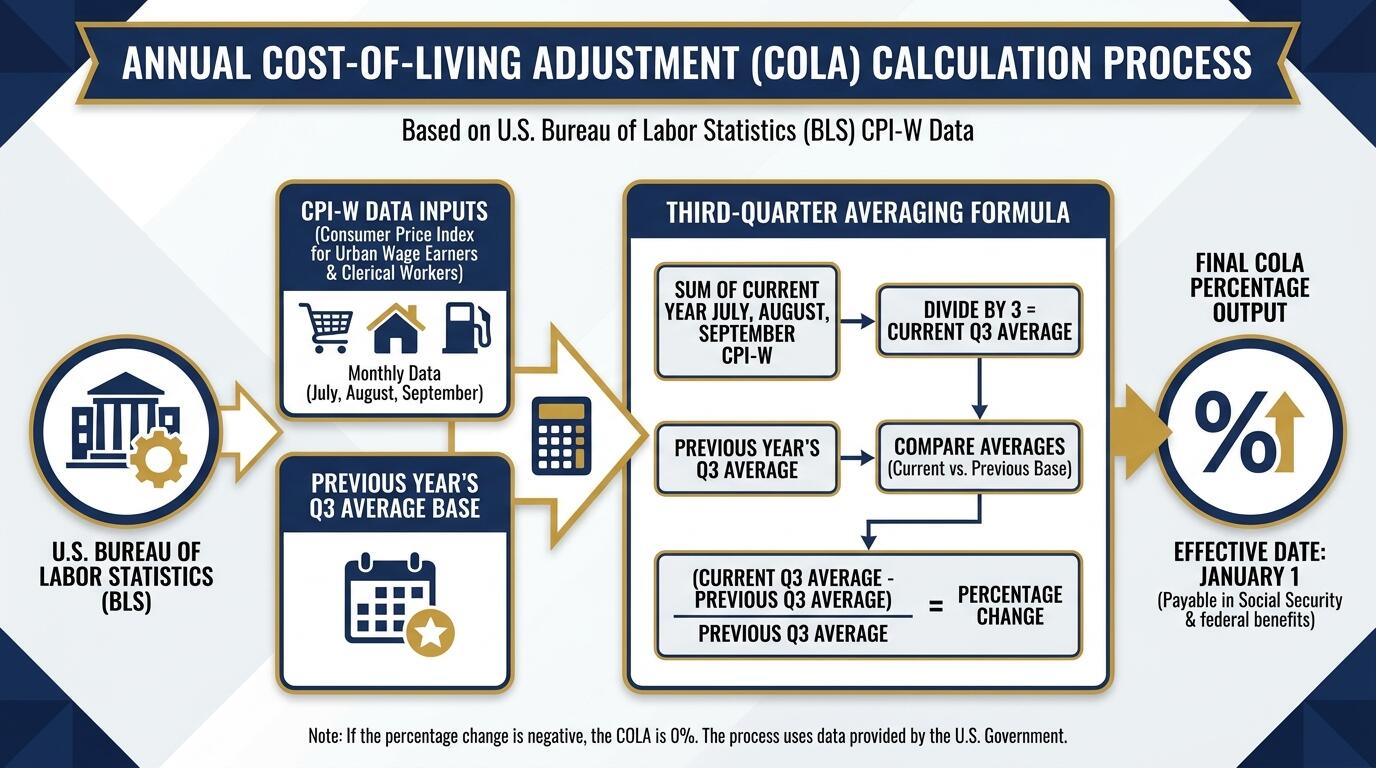
ALT: Diagram showing how the cost-of-living adjustment is calculated each year using CPI data
Why the Cost-of-Living Adjustment Matters More Than Most People Realize
Key Conclusion: The cost-of-living adjustment (COLA) is an annual change applied to certain payments — most notably Social Security benefits — designed to keep pace with inflation. It is calculated using data from the Consumer Price Index for Urban Wage Earners and Clerical Workers (CPI-W), measured by the U.S. Bureau of Labor Statistics. Understanding how COLA is determined each year helps everyday people anticipate shifts in their retirement income, workplace salaries, and purchasing power — and why it often falls short of what rising prices actually feel like at the grocery store.
Every fall, millions of Americans receive news about an upcoming adjustment to their Social Security checks, pension payments, or employment contracts. Sometimes the change is celebrated; other times it barely registers against the tide of rising prices. Yet for all the attention COLA announcements receive, surprisingly few people understand the mechanics behind the number itself.
In our work explaining financial headlines, we find that COLA is one of the most consistently misunderstood concepts in personal finance. People see the percentage, feel its inadequacy at the cash register, and assume something has gone wrong — when in reality, the figure is the output of a fairly transparent, rules-based process. Once you understand that process, the number starts to make a lot more sense, even if you don't always like the result.
This article walks through exactly how the annual cost-of-living adjustment is calculated, where the data comes from, what factors it captures (and misses), and why the formula has become a recurring source of debate.
Who This Explanation Applies To
This breakdown is directly relevant if you receive Social Security retirement, disability, or survivor benefits; participate in a federal or state pension plan; have an employment contract with a COLA clause; or are simply a curious reader trying to understand why your benefits didn't seem to keep up with what you paid for groceries last year.
It is less directly applicable in these situations: if your income comes entirely from private-sector wages without a COLA clause, your employer sets raises independently and inflation adjustments are negotiated rather than formula-driven. Likewise, if you are evaluating investment strategies or seeking advice on how to personally beat inflation, this article is educational context — not financial guidance.
The Background: Where COLA Comes From and Why It Exists
The cost-of-living adjustment is a mechanism designed to preserve the real purchasing power of fixed or semi-fixed payments over time. Without it, inflation would steadily erode the value of a fixed benefit — a retiree receiving the same nominal dollar amount year after year would effectively be getting poorer each year as prices rose around them.
The modern Social Security COLA process was formalized through the 1972 amendments to the Social Security Act, which introduced automatic annual adjustments tied to inflation data. Before that, Congress had to pass legislation each time it wanted to increase benefits — a slow and politically uncertain process. Automating the adjustment was intended to remove the political volatility and give beneficiaries a predictable, rules-based guarantee.
The mechanism spread beyond Social Security. Federal employee pay scales, military retirement benefits, Supplemental Security Income (SSI), and many private and public pension systems now incorporate some form of cost-of-living adjustment — though the specific formulas vary considerably from program to program.
For a deeper look at how these kinds of government economic decisions ripple into everyday life, the Social Security's 2027 COLA Explained: What Retirees Need to Know is a useful companion read that covers practical impact alongside the mechanics.
How the Calculation Actually Works
Step 1: Identify the Correct Index — CPI-W
The primary data source for the Social Security COLA calculation is the Consumer Price Index for Urban Wage Earners and Clerical Workers, commonly abbreviated as CPI-W. This is a specific subset of the broader Consumer Price Index, published monthly by the U.S. Bureau of Labor Statistics (BLS). The CPI-W tracks price changes for a basket of goods and services consumed by urban workers — things like food, housing, transportation, medical care, apparel, and recreation. Each category is weighted according to how much of a typical worker's budget it represents. This is an important detail: the index is built around spending patterns of working-age urban consumers, not retirees or rural households, which has significant implications we will return to later.
Step 2: Measure the Third-Quarter Average
Not every month of CPI-W data is used in the COLA calculation. The Social Security Administration (SSA) compares the average CPI-W reading for the third quarter of the current year — meaning July, August, and September — against the average CPI-W reading for the third quarter of the previous year (or the most recent year in which a COLA was applied). This is why the official COLA announcement typically arrives in October each year, shortly after the September CPI-W data is published by the BLS.
The formula is straightforward: subtract the base period's average CPI-W from the current period's average, divide the result by the base period's average, and multiply by 100. The resulting percentage, rounded to the nearest tenth of a percent, becomes the COLA. If the result is zero or negative — meaning prices did not rise above the baseline — the COLA is zero; benefits do not decrease.
Step 3: Apply the Adjustment to Benefits
Once the percentage is determined, it is applied uniformly across eligible Social Security and SSI payments beginning with the payments issued in January of the following year. A beneficiary receiving a given monthly payment will see that amount multiplied by one plus the COLA rate. Because the adjustment compounds over time — each new COLA is applied to the already-adjusted benefit — the effect accumulates meaningfully over a long retirement.
Comparing COLA Across Different Programs
Not every program that offers a cost-of-living adjustment uses the same formula or the same index. The differences matter more than most people realize, and they partly explain why beneficiaries in different programs experience the adjustment very differently.
Comparison Dimension — Social Security / SSI — Federal Employee Retirement (FERS) — Private Pension Plans
Index Used — CPI-W (Third-quarter average) — CPI-W (same BLS source) — Varies by plan; may use CPI-U or negotiated formula
Adjustment Trigger — Automatically applied if CPI-W rises — Automatically applied; may be capped — Depends on plan document; some have no automatic COLA
Cap on Increase — No statutory cap — FERS COLAs are capped or reduced when CPI-W exceeds certain thresholds — Typically capped at a plan-defined maximum
Effective Date — January of following year — Usually January — Varies by plan
Minimum Adjustment — Zero (no decrease) — Zero (no decrease) — Varies; some plans can reduce payments
This table illustrates why two retirees — one on Social Security, one on a private pension — can receive very different effective adjustments even in the same inflationary environment. Federal workers under the Federal Employees Retirement System (FERS) face a more complex adjustment schedule: when inflation is moderate, FERS retirees receive the full CPI-W increase, but when inflation runs higher, their adjustment is reduced compared to Social Security recipients, per rules established under federal pension law.
The CPI-W vs. CPI-E Debate: Who Is the Index Actually Measuring?
One of the most persistent criticisms of the current COLA formula centers on a basic mismatch: the CPI-W is built around the spending habits of urban wage earners and clerical workers — a relatively young, working-age population. Social Security's largest group of beneficiaries, however, consists of retirees, many of whom are significantly older than the index's reference population.
Older adults tend to spend a larger share of their income on medical care, including prescription drugs, medical devices, and healthcare services. Medical costs have historically risen faster than overall inflation in many periods. Because the CPI-W assigns a relatively modest weight to medical spending, COLA adjustments may systematically undercompensate retirees whose out-of-pocket healthcare costs are climbing faster than the index captures.
This gap prompted the BLS to develop an experimental index called the Consumer Price Index for the Elderly (CPI-E), which reweights spending categories to better reflect the consumption patterns of Americans aged 62 and older. Research has consistently shown that the CPI-E tends to rise somewhat faster than the CPI-W over time — meaning that if Social Security COLAs were based on CPI-E, annual adjustments would likely be modestly higher. As of now, however, the CPI-E remains experimental and is not used in any official COLA calculation, though it surfaces regularly in policy discussions about Social Security reform.
ALT: Step-by-step illustration of how CPI-W data feeds into the annual cost-of-living adjustment calculation for Social Security
Edge Cases, Misconceptions, and What COLA Cannot Do
When inflation turns negative. The COLA floor is zero — benefits cannot be reduced in a year of deflation. This sounds reassuring, but it creates a technical complication: in a year where the COLA is zero, the comparison baseline for the next year's calculation is adjusted accordingly. The SSA uses the highest CPI-W average on record (the "high watermark") as the base, meaning beneficiaries must "wait out" a low-inflation period before the next positive COLA kicks in. It is not a loss of money, but it can feel like a stagnation that outlasts actual deflation.
COLA is not the same as a raise. A cost-of-living adjustment is designed to maintain purchasing power, not increase it. If a recipient's benefit goes up by 3% and overall prices rose 3%, the recipient is — in theory — in the same real position as before. COLA does not improve a beneficiary's standard of living; it tries to prevent it from deteriorating. Many people confuse the two, which leads to frustration when a COLA that sounds large still doesn't stretch at the checkout line.
Employer COLAs work differently. In private employment, a COLA clause in a contract or collective bargaining agreement may reference the CPI-W, the broader CPI-U (Consumer Price Index for All Urban Consumers), or a custom formula. Some employer COLAs are discretionary rather than automatic. This is an area where workers often assume more protection than their contract actually provides, making it worth reading the specific terms carefully. The distinction between mandatory and discretionary adjustments can make an enormous practical difference, particularly in high-inflation periods.
Geographic variation is real. The CPI-W is a national average. Inflation in a high-cost urban market can run meaningfully higher than the national figure, while rural areas may experience lower price pressures. A COLA calibrated to national data cannot fully account for this geographic dispersion — a retiree in a rapidly rising housing market may find the adjustment particularly inadequate.
It is worth noting that inflation's effects on household budgets extend well beyond COLA mechanics. Understanding how interest rate decisions by the Federal Reserve interact with inflation — and therefore with the purchasing power COLA tries to protect — adds important context. The relationship between Federal Reserve rate decisions and your savings is one way to see how monetary policy and cost-of-living adjustments work in the same ecosystem.
Q1: How does the Social Security Administration know what COLA percentage to announce each October?
The Social Security Administration calculates the COLA by comparing the average CPI-W reading for July, August, and September of the current year to the same three-month average from the prior year (or the most recent year in which a COLA was granted). The U.S. Bureau of Labor Statistics publishes the final September CPI-W figure in mid-October, which gives the SSA the last data point it needs to complete the calculation and make its official announcement. The process is automatic and formula-driven — no Congressional vote is required.
Q2: Is the CPI-W the most accurate measure of retirees' actual inflation experience?
No — and this is one of the most discussed limitations of the current system. The CPI-W is designed to reflect the spending patterns of urban wage earners and clerical workers, not retirees. Because older adults spend proportionally more on medical care — which tends to inflate faster than general goods — the CPI-W can underestimate the inflation that retirees actually experience. The experimental CPI-E index developed by the Bureau of Labor Statistics attempts to correct for this, but it has not been adopted for official COLA calculations as of the current policy framework.
Q3: How long does it take for a COLA to show up in a beneficiary's payment?
Once the Social Security Administration announces the COLA in October, the adjusted payment amount takes effect in January of the following year. For most Social Security recipients, this means the first check or direct deposit of the new year will reflect the updated amount. The delay between announcement and payment is roughly two to three months. Supplemental Security Income (SSI) recipients typically see the adjustment in their December payment, since SSI payments are issued a month ahead of Social Security.
Wrapping Up
The annual cost-of-living adjustment is one of the most consequential — and widely misunderstood — financial mechanisms affecting millions of Americans. Three points deserve to stay with you after reading this.
First, the formula is transparent and rules-based: it compares third-quarter CPI-W averages year over year, and the resulting percentage is applied uniformly across eligible programs. There is no mystery, only data.
Second, the index has real limitations. Because it reflects working-age urban spending patterns, it may systematically underestimate the inflation experienced by older retirees, particularly in medical costs. The debate over CPI-E versus CPI-W is not academic — it has direct implications for whether fixed-income seniors are genuinely keeping pace with their actual costs.
Third, COLA preserves purchasing power in theory but cannot override structural mismatches between the index and individual circumstances — geography, health expenses, and housing costs all create gaps between what the number says and what a household actually feels.
The most productive next step is to find out exactly what index and formula governs any COLA clause that applies to your specific situation — whether it's a Social Security benefit, a pension, or an employment contract. The formula in this article covers the Social Security standard, but your personal adjustment may follow different rules.
Want to make sense of the financial headlines that shape your income and purchasing power? Vega Brief breaks down complex economic, market, and personal finance news into clear, plain-English explainers — strictly educational and always source-linked. Visit to stay informed and build your financial literacy, one story at a time.
References
U.S. Social Security Administration. "Cost-of-Living Adjustment (COLA) Information."
https://www.ssa.gov
U.S. Bureau of Labor Statistics. "Consumer Price Index — CPI-W and CPI-E Overview."
https://www.bls.gov
Texas Municipal Retirement System. "Cost of Living Adjustment (COLA) Calculation Fact Sheet."
https://www.tmrs.com/uploads/files/general/down/flyers/COLA_Calculation_Fact_Sheet.pdf
Western & Southern Financial Group. "Social Security COLA 2026: Increase, Calculation & Impact."
https://www.westernsouthern.com/retirement/what-is-social-security-cola
Note: Government policies and index methodologies are subject to change; always verify current information through official sources or qualified advisors.
For educational purposes only. Not investment advice. We do not recommend any stock, fund, broker or trading platform. Headlines are sourced from Google News · Business; every story links to the original publishers.