How Government Shutdown Risk Could Ripple Through Markets This Quarter
ALT: Government shutdown risk rippling through stock markets and economy this quarter
For educational purposes only. Not investment advice.
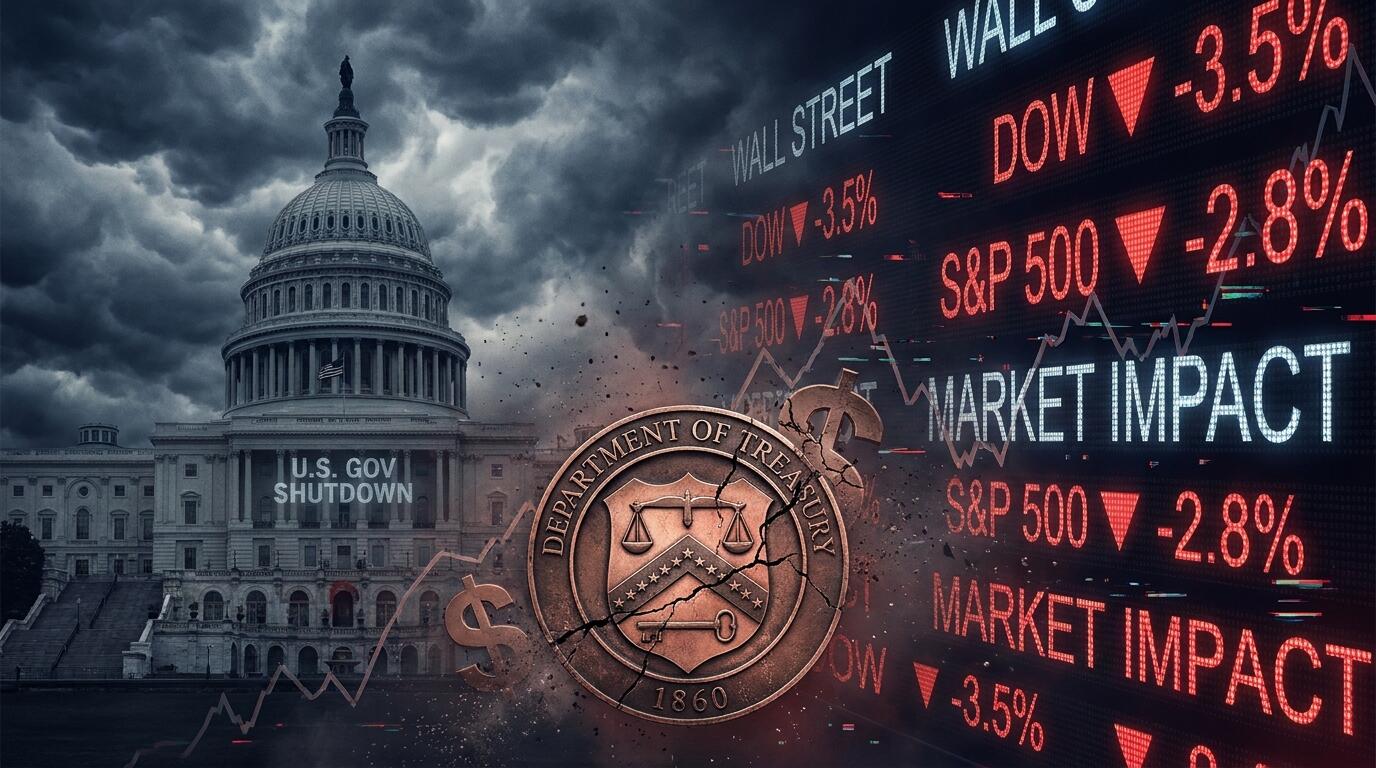
ALT: Government shutdown risk rippling through stock markets and economy this quarter
When Washington Stalls, Wall Street Pays Attention: Understanding Shutdown Risk This Quarter
Key Conclusion: Government shutdown risk is a recurring fiscal event in the United States that can create measurable turbulence across financial markets — affecting Treasury yields, stock indices, the dollar, and economic data releases. This quarter, elevated political tensions over federal spending have put shutdown risk back on investors' radar. Understanding how a shutdown unfolds, which market segments feel it first, and how quickly conditions can change is essential for anyone trying to make sense of today's financial headlines.
A government shutdown is not an abstract political event — it is a real disruption to the machinery of public spending, data reporting, and economic confidence that markets price in real time. When Congress fails to pass a budget or continuing resolution before a funding deadline, federal agencies are forced to halt non-essential operations until lawmakers reach an agreement. The ripple effects spread faster and further than most people expect, touching everything from mortgage rates to stock volatility. In this article, we break down exactly how that happens, why it matters this quarter specifically, and what patterns observers consistently see when shutdown risk rises.
Who This Explainer Is For — And What It Does Not Cover
Applicable Scenarios:
Readers who want to understand why financial news headlines mention "government shutdown" in the same breath as market movements
Young professionals, students, or general news consumers trying to connect political headlines to personal finance and economic trends
Anyone preparing for a job interview, exam, or informed conversation about U.S. fiscal policy and its market implications
Not Applicable/Cautions:
This article does not constitute investment advice and should not be used to make buy, sell, or hold decisions about any financial instrument
Readers seeking legally binding fiscal or tax guidance should consult a qualified financial or legal professional
The Mechanics Behind a Government Shutdown — and Why Markets Care
A U.S. government shutdown occurs when Congress fails to authorize new spending legislation — typically either a full-year appropriations bill or a short-term continuing resolution — before the current funding period expires. Without that authorization, the Treasury Department cannot legally disburse funds to most federal agencies, which must then suspend all but essential operations until the impasse is resolved. Essential services — like military operations, Social Security payments, and air traffic control — generally continue, but thousands of federal workers are furloughed, contractors go unpaid, and a wide swath of government functions simply goes dark.
This matters to markets because the U.S. federal government is the single largest participant in the American economy. Federal spending touches defense contractors, healthcare providers, research institutions, and infrastructure companies. When that spending is suddenly cut off — even for a few weeks — the effects cascade through supply chains and earnings forecasts. Beyond direct spending, shutdowns also freeze the government agencies that produce the economic data that markets rely on. The Bureau of Labor Statistics, for example, may delay its monthly jobs report. The Census Bureau may suspend retail sales data. When investors cannot see the economic dashboard clearly, uncertainty rises — and markets generally price uncertainty with higher volatility.
The Congressional Budget Office and the White House Office of Management and Budget are the two primary institutions that track and estimate the economic cost of shutdowns. Historical shutdown episodes have shown that prolonged closures — lasting more than two to three weeks — produce measurable drags on GDP growth, according to analyses published by U.S. government agencies. Shorter shutdowns, while disruptive, tend to have impacts that are largely reversed once the government reopens.
This quarter, the political conditions that tend to produce shutdown risk are present: a divided or closely contested legislative chamber, competing spending priorities, and approaching fiscal deadlines. The pattern of late-cycle budget negotiations putting markets on edge is one that analysts at Vega Brief observe appearing repeatedly in financial coverage, making it a topic worth explaining clearly before the noise gets too loud.
ALT: Flowchart illustrating how a U.S. government shutdown disrupts federal spending, economic data, and financial market sentiment
Reading the Signals Before a Shutdown Happens
Step 1: Recognize When Shutdown Risk Becomes a Market Conversation
Shutdown risk becomes a genuine market variable when a funding deadline is close — typically within four to six weeks — and congressional negotiations appear stuck. The clearest signal is when the political news cycle shifts from routine budget debate to active talk of a funding lapse. During this window, credit rating agencies sometimes issue cautionary statements, and Treasury market participants begin adjusting positions. Watch for rising yields on short-term Treasury bills with maturity dates that fall just after the deadline — that spread is a real-time indicator of investor unease.
Step 2: Understand Which Asset Classes Feel the Pressure First
Once shutdown risk is priced into the conversation, different corners of the market react in sequence. U.S. Treasury markets typically move first, because a shutdown does not directly threaten the government's ability to pay existing debt — but it does create noise around economic data and fiscal credibility. Equity markets respond next, with sectors that are directly dependent on federal contracts — defense, government technology, and healthcare — tending to show the most sensitivity. The U.S. dollar can weaken modestly if global investors interpret shutdown risk as a signal of political dysfunction, though this effect is historically short-lived.
Step 3: Track the Resolution Timeline — Because Markets Do
Most shutdowns are resolved within days to a few weeks. Markets have learned to treat short shutdowns as manageable disruptions rather than structural crises. The calculus changes, however, if a shutdown coincides with other stressors — a debt ceiling standoff, elevated inflation, or fragile banking conditions. In those cases, the combined uncertainty can push volatility indices meaningfully higher and cause a broader pullback in risk assets. Monitoring the legislative calendar, particularly whether a continuing resolution has bipartisan support, gives observers a forward-looking read on how quickly the risk might be resolved.
Sector-by-Sector Sensitivity: Who Gets Hit Hardest
Different sectors of the equity market carry very different exposures to government shutdown risk. Understanding these distinctions helps cut through the generalized alarm that often dominates financial headlines.
Sector — Direct Exposure — Indirect Exposure — Typical Market Reaction
Defense & Aerospace — High — relies heavily on federal contracts — Moderate — supply chain disruptions — Stock price sensitivity, delayed contract awards
Government Technology — High — federal IT contracts may be paused — Low — Earnings estimate revisions during long shutdowns
Healthcare / Biomedical — Moderate — NIH and FDA slowdowns — Moderate — drug approval delays — Regulatory uncertainty premium
Financial Services — Low direct — Moderate — delayed economic data affects lending decisions — Increased volatility, wait-and-see positioning
Consumer Staples — Very low direct — Low — Generally resilient, mild safe-haven demand
Utilities — Very low direct — Low — Often treated as defensive, mild upward pressure
The table above illustrates a consistent pattern: sectors with the highest revenue concentration in federal spending react most sharply to shutdown news, while consumer-facing and utility businesses are relatively insulated.
The Treasury Market and the Dollar — Two Signals Worth Watching
The U.S. Treasury market is arguably the most important financial market in the world, serving as a benchmark for borrowing costs everywhere from corporate bonds to home mortgages. When shutdown risk rises, two things can happen in Treasuries simultaneously, and they can appear contradictory at first glance.
On one hand, investors often buy Treasury bonds as a safe-haven asset during periods of political uncertainty — driving prices up and yields down. On the other hand, if a shutdown drags on long enough to raise questions about the government's fiscal management, yields on short-term bills can rise as investors demand a small risk premium for bills that mature during the uncertainty window.
The net effect in most historical episodes has been modest and temporary. But in a quarter when interest rate sensitivity is already elevated — for instance, when the Federal Reserve is actively managing monetary policy — even small moves in Treasury yields can amplify across mortgage markets and corporate credit.
The U.S. dollar tends to weaken slightly during high-profile shutdown episodes, reflecting reduced global confidence in American political stability. This matters for multinational corporations that report earnings in dollars, as a weaker dollar can flatter overseas revenues. It also affects commodity prices, since most globally traded commodities are priced in dollars — a weaker dollar typically supports commodity prices like oil and gold. These connections help explain why a political standoff in Washington can show up in the price of crude oil or gold futures.
The Data Blackout Problem — Why Shutdown Timing Matters
One of the least-discussed but most practically important consequences of a government shutdown is the disruption to economic data releases. The Bureau of Labor Statistics, the Bureau of Economic Analysis, and the Census Bureau all suspend data publication during a shutdown. This means that scheduled reports — jobs numbers, inflation readings, GDP estimates, retail sales figures — may be delayed or canceled entirely.
For financial markets, this is not a trivial inconvenience. Market pricing, Federal Reserve policy decisions, and business planning are all calibrated against a continuous flow of economic data. When that data stops, investors and policymakers are effectively flying with reduced instrumentation. The Federal Reserve, for example, has historically noted that prolonged data blackouts complicate its ability to assess economic conditions and calibrate monetary policy. This adds a layer of uncertainty that goes beyond the shutdown itself.
The timing of a shutdown within the economic calendar therefore matters greatly. A funding lapse that coincides with a major data release window — such as the monthly payrolls report or the quarterly GDP advance estimate — creates a more acute information vacuum than one that falls during a quieter period. This quarter, the economic calendar is dense with high-stakes releases, which heightens the sensitivity of markets to any lapse in government funding.
Advanced Considerations: When Shutdown Risk Intersects With Other Pressures
Government shutdown risk rarely arrives in isolation. The most market-moving episodes in recent history have occurred when a shutdown threat overlapped with at least one other major financial stressor.
The debt ceiling interaction is the most important of these overlaps. The debt ceiling is a legal limit on how much the U.S. government can borrow. When a shutdown coincides with a debt ceiling standoff — meaning the government is both unable to spend through a shutdown and at risk of running out of borrowing authority — markets can react with much greater severity than they would to either event alone. Credit rating agencies have cited debt ceiling brinksmanship as a factor in assessments of U.S. fiscal credibility. This quarter, observers should pay close attention to whether funding deadline talks are entangled with broader debt limit discussions.
Federal Reserve policy overlap creates a second complication. When the Fed is in the middle of an active rate cycle — either raising or cutting rates — shutdown uncertainty can muddy the signal that policymakers are trying to read from economic data. Fed officials have explicitly noted in public communications that data disruptions caused by shutdowns complicate their ability to assess the economy in real time.
A common misconception is that government shutdowns automatically cause stock market crashes. Historical data does not support this. Many past shutdowns — including some that lasted weeks — produced only modest, temporary drawdowns in major stock indices. The market's response depends heavily on duration, concurrent macroeconomic conditions, and investor expectations. A shutdown that is resolved quickly and is well-anticipated by markets is far less damaging than one that is prolonged and arrives alongside other economic shocks.
How does a government shutdown directly affect the stock market?
A government shutdown affects the stock market primarily through three channels: reduced federal spending that hits contractor-dependent sectors, disruption of economic data that markets use to set prices, and a general rise in political uncertainty that can increase volatility. The magnitude of the impact depends on shutdown duration and timing. Most short shutdowns — resolved within one to two weeks — produce limited and quickly reversed market effects, according to historical analyses by Congressional Budget Office economists and market researchers.
Is a government shutdown the same as a debt default?
No. A government shutdown and a debt default are fundamentally different events. A shutdown occurs when Congress fails to pass a spending bill, causing non-essential federal operations to halt. The government still pays its existing debts — bondholders continue to receive interest payments. A debt default would occur only if the government failed to make required debt payments, which would require a separate breach of the debt ceiling. The distinction is critical: a default would be far more severe for markets than any historical shutdown.
How long do government shutdowns typically last, and when do markets recover?
The duration of government shutdowns in the United States has ranged from a single day to more than a month in the most prolonged modern case. Most shutdowns are resolved within days to two weeks. Historical market data suggests that equity markets tend to recover quickly after a resolution is announced — often recouping shutdown-period losses within a few trading sessions. Recovery is faster when the shutdown was anticipated by markets and when no simultaneous macroeconomic shocks are present.
Summary
Government shutdown risk is a predictable, recurring feature of U.S. fiscal politics — one that markets have learned to price with a blend of caution and pragmatism. Understanding its mechanics helps readers cut through the noise of political headlines and identify which signals actually matter for economic and market conditions.
Key Takeaways:
A government shutdown occurs when Congress fails to authorize federal spending before a funding deadline, triggering a halt to non-essential government operations.
Markets most affected in the near term include sectors with heavy federal revenue exposure — defense, government technology, and biomedical research — while consumer and utility sectors tend to be more resilient.
Treasury markets and the U.S. dollar show measurable but typically modest and temporary responses to shutdown risk; the effects are amplified when shutdown risk overlaps with debt ceiling tension or active Fed policy cycles.
The disruption of economic data releases during a shutdown creates an information vacuum that complicates market pricing and Federal Reserve decision-making.
Most shutdowns are resolved within weeks, and historical market evidence shows that short, anticipated shutdowns produce limited lasting damage — but prolonged or poorly-timed shutdowns carry greater risk.
The clearest next step for any reader trying to stay ahead of this story is to track three things: the proximity of the funding deadline, whether a continuing resolution has bipartisan support, and whether the shutdown risk is entangled with the debt ceiling. Those three variables, taken together, give the most reliable read on whether this quarter's risk is routine or something more serious.
Want to actually understand what's happening in the markets and economy — without drowning in jargon? Visit Vega Brief for plain-English explainers on the financial headlines that matter most to you. Every story is AI-assisted, source-linked, and strictly educational, so you can stay informed and think for yourself.
Sources & Further Reading
U.S. Congressional Budget Office. "The Effects of Government Shutdowns on the Economy and Federal Operations".
https://www.cbo.gov
U.S. Bureau of Labor Statistics. "Economic Data and Publications — Federal Statistical Agency Operations".
https://www.bls.gov
U.S. Department of the Treasury. "Federal Funding, Debt Ceiling, and Government Operations Guidance".
https://www.treasury.gov
Note: Government fiscal policies, funding deadlines, and economic data schedules change frequently. Always consult the latest official publications from the relevant federal agencies or qualified financial professionals for current information.
For educational purposes only. Not investment advice. We do not recommend any stock, fund, broker or trading platform. Headlines are sourced from Google News · Business; every story links to the original publishers.