How the Federal Reserve's Current Rate Decisions Affect Your Mortgage and Savings
ALT: Federal Reserve interest rate decision impact on mortgage rates and personal savings accounts
For educational purposes only. Not investment advice.
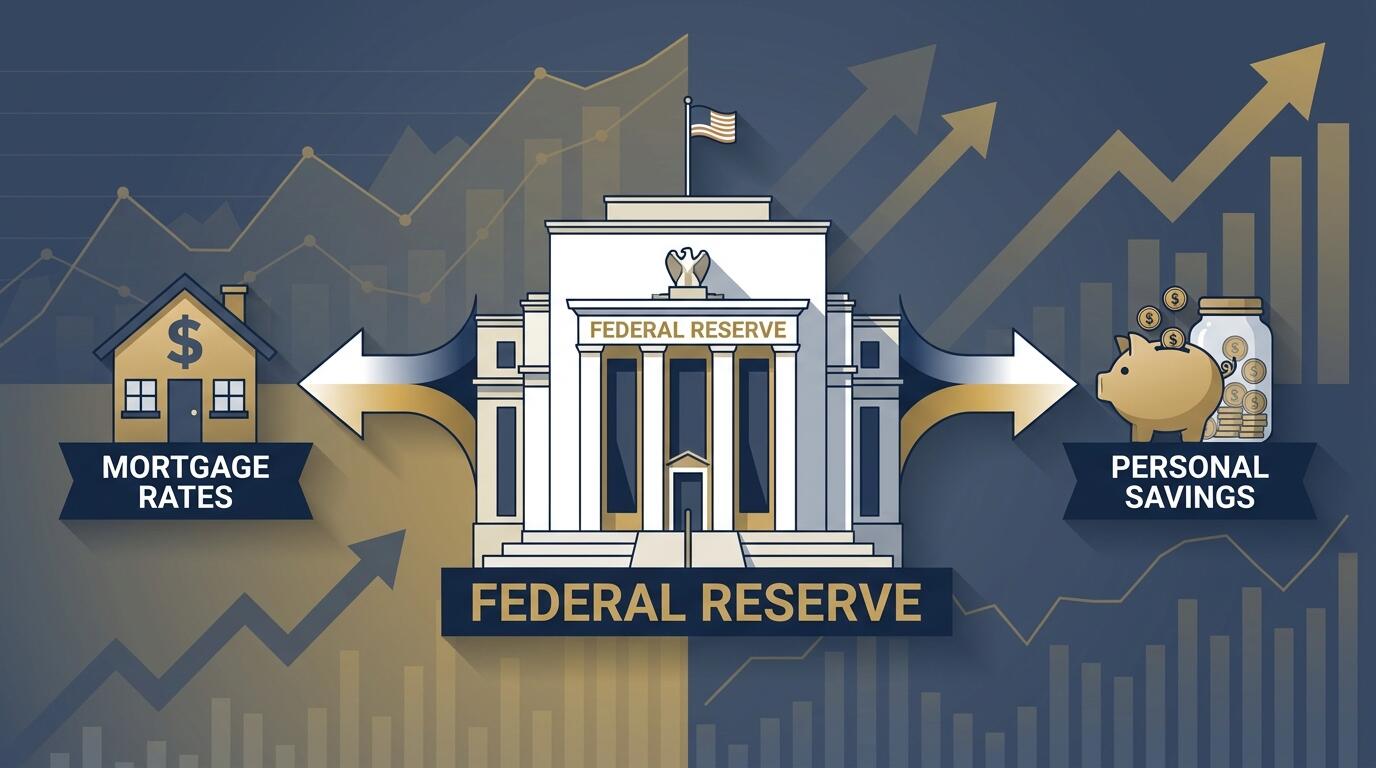
ALT: Federal Reserve interest rate decision impact on mortgage rates and personal savings accounts
What You'll Understand After Reading: How Fed Rate Decisions Shape Your Mortgage and Savings
Key Conclusion: The Federal Reserve's decisions on interest rates have a direct and measurable effect on both mortgage costs and savings account yields. When the Fed raises its benchmark rate, borrowing becomes more expensive and savings accounts tend to pay more. When it cuts rates, mortgages can become cheaper but savings returns shrink. Understanding this relationship helps everyday consumers make more informed decisions about their finances — without needing a degree in economics.
Most financial news coverage of the Federal Reserve tends to fall into one of two traps: it either buries the real-world impact in technical language, or it oversimplifies the mechanics to the point of being misleading. The result is that millions of people hear phrases like "the Fed held rates steady" or "the FOMC raised the federal funds rate by 25 basis points" and have no clear sense of what that means for their rent, their mortgage payment, or the interest on their savings account. This guide is designed to close that gap — walking you through exactly how Fed rate policy translates into the financial outcomes that affect your daily life.
Before You Start: What You Need to Know to Follow Along
You do not need to be an economist to understand how the Federal Reserve affects your finances. But a few foundational concepts will make everything that follows significantly clearer. Think of this section as a short briefing before you step into the room where the decisions are made.
The Federal Reserve — often called "the Fed" — is the central bank of the United States. It is not a commercial bank where you can open an account. Instead, it operates as a banking system for banks themselves, setting the rules and rates that ripple outward into the broader economy. The Fed's primary tool for influencing economic activity is the federal funds rate, which is the interest rate at which banks lend money to each other overnight.
That rate sounds abstract, but its effects are anything but. When the Fed moves the federal funds rate up or down, every other interest rate in the economy — from your mortgage to your car loan to your savings account — tends to move in the same direction, though not always immediately or by the same amount.
Here are the core concepts you will encounter in this article:
Federal funds rate: The benchmark interest rate the Fed sets, which influences the cost of borrowing throughout the economy.
Mortgage rate: The interest rate a lender charges you to borrow money to purchase a home. It is distinct from the federal funds rate but closely influenced by it.
Annual Percentage Yield (APY): The effective annual return on a savings account or other deposit product, accounting for compounding. When the Fed raises rates, APYs on savings accounts often rise.
Basis point: One-hundredth of one percentage point. A 25-basis-point rate hike equals a 0.25% increase. This is the standard unit of measurement in Fed policy discussions.
FOMC: The Federal Open Market Committee, the body within the Federal Reserve that votes on interest rate decisions. It meets several times per year.
Knowing these terms before diving in means you will not have to pause and decode jargon mid-read. That is the approach we consistently take at Vega Brief — building just enough context first so that the explanation that follows actually lands.
A qualitative sense of the current environment is also useful: interest rate policy has been an unusually active area of financial news in recent years, with rates moving significantly in both directions over a relatively short period. The specific numbers at any given moment matter less than understanding the mechanics — because those mechanics do not change, even when the numbers do.
Checklist before starting:
Familiarity with what a central bank does (even at a basic level)
A rough sense of whether you currently have or are considering a mortgage or savings account
Willingness to think about your personal finances as part of a larger economic system
ALT: Diagram illustrating how Federal Reserve benchmark rate decisions flow through to mortgage rates and high-yield savings account APYs
Step 1: Understand the Starting Point — What the Fed Actually Controls
The Federal Reserve directly controls only one rate: the federal funds rate. This is the rate at which commercial banks borrow from each other on a short-term (typically overnight) basis. The Fed does not set mortgage rates directly, nor does it set the rates your bank pays on savings accounts. What it sets is the foundational cost of money — and that foundation shapes everything built on top of it.
When the FOMC votes to raise the federal funds rate, it is making it more expensive for banks to access short-term capital. Banks, in turn, pass that cost along by raising the rates they charge on loans and, to varying degrees, the rates they offer on deposits.
Tip: A useful mental model is to think of the federal funds rate as the wholesale price of money. Just as a retailer raises prices when wholesale costs go up, banks raise their lending rates — and sometimes their deposit rates — when the cost of borrowing from each other increases.
Step 2: Trace the Path From Fed Rate to Mortgage Rate
Mortgage rates do not move in lockstep with the federal funds rate. Instead, they are more closely tied to the yield on 10-year U.S. Treasury notes — because mortgages are typically 15- or 30-year instruments, and the bond market prices long-term risk differently than short-term borrowing costs.
However, the Fed's rate decisions do influence Treasury yields, particularly when they signal the direction of future policy. If the Fed signals it will keep rates higher for longer to combat inflation, bond investors adjust their expectations, and yields on long-term Treasuries tend to rise. Mortgage rates follow. Conversely, when the Fed signals rate cuts are coming, mortgage rates often begin to ease — sometimes even before the cuts officially happen.
For a practical illustration: a household taking out a 30-year fixed mortgage when rates are elevated will pay substantially more in total interest over the life of the loan compared to the same loan taken out in a lower-rate environment. The monthly payment difference on a typical loan can amount to hundreds of dollars per month, depending on the rate differential and the loan size.
Tip: Watch 10-year Treasury yield movements alongside Fed announcements. If Treasuries are rising even as the Fed holds steady, mortgage rates may still climb — a nuance that many mainstream news summaries miss entirely.
Step 3: Understand How Fixed vs. Adjustable Mortgages React Differently
Not all mortgages respond to Fed decisions in the same way. Fixed-rate mortgages are set at origination and do not change. If you locked in a 30-year fixed rate during a period of low rates, your payment does not change when the Fed raises rates later. Your rate is insulated from future Fed decisions — for better or worse.
Adjustable-rate mortgages (ARMs), by contrast, are specifically designed to reset periodically based on a reference index — and those indexes are directly influenced by the federal funds rate. A 5/1 ARM, for example, holds a fixed rate for five years, then adjusts annually based on a benchmark index plus a margin. When the Fed has raised rates aggressively, the reset on an ARM can result in a noticeably higher monthly payment.
In a pattern we consistently observe when explaining financial news to general audiences, people are often surprised to discover that their ARM adjustment is a direct downstream consequence of a Fed policy decision they heard about months earlier but did not connect to their personal situation.
Tip: If you currently hold an adjustable-rate mortgage, check your loan documents for the specific index your rate is tied to (common ones include the Secured Overnight Financing Rate, or SOFR) and monitor Fed signals around each adjustment period.
Step 4: See How the Fed Rate Affects Your Savings Account
While rising rates can be painful for borrowers, they are generally beneficial for savers — at least in theory. When the Fed raises the federal funds rate, banks can earn more by lending money, which creates some incentive for them to attract deposits by offering higher APYs.
The key caveat is that not all banks pass rate increases along to depositors equally or quickly. Large traditional banks with established customer bases historically move more slowly to raise savings rates than online banks or credit unions competing aggressively for deposits. High-yield savings accounts — typically offered by online-only banks or fintech platforms — have tended to respond more quickly to rising Fed rates.
The Washington State Department of Financial Institutions notes in its consumer education materials that understanding savings account structures, including how APYs are calculated and compounded, is fundamental to making informed decisions about where to keep your money. When rates are rising, comparing APYs across different account types becomes especially worthwhile.
Tip: The gap between what the largest traditional banks pay in savings APYs and what competitive online institutions offer can be significant in a high-rate environment. This is not a minor rounding difference — it can represent a meaningful difference in real annual returns on the same deposit.
Step 5: Factor in the Inflation Context Behind Fed Decisions
The Federal Reserve does not raise or cut rates in a vacuum. Its decisions are driven primarily by two mandates: maintaining price stability (controlling inflation) and achieving maximum employment. Understanding why the Fed is moving rates helps you predict where rates might go next — and how long any given environment might last.
When inflation is elevated, the Fed typically raises rates to cool economic activity. Higher borrowing costs reduce consumer spending and business investment, which tends to bring prices down over time. This is the intended mechanism. For savers, a high-rate, high-inflation environment is a mixed picture: savings accounts may pay more in nominal terms, but the real return (adjusted for inflation) may still be modest or negative.
For mortgage borrowers, a high-inflation environment is doubly challenging: rates are elevated precisely because prices are rising, meaning the cost of borrowing is high at the same time that the cost of living is increasing.
Tip: When evaluating your savings account returns, compare the APY not just to other savings rates but to the current inflation rate. The difference — your real return — is what actually matters for preserving purchasing power.
Step 6: Recognize the Time Lag Between Fed Decisions and Real-World Effects
Fed decisions do not translate into changed mortgage rates or savings APYs overnight. There is a transmission lag — the time it takes for policy changes to ripple through financial markets, lending institutions, and ultimately consumer products.
For mortgages, the bond market often begins pricing in anticipated Fed moves before they happen, meaning rates can shift in advance of an actual FOMC decision. For savings accounts, banks typically adjust rates after a decision is confirmed, and the adjustment speed varies by institution.
This time lag has important practical implications. Locking in a mortgage rate shortly before an expected Fed rate hike can offer some protection from the increase. Waiting to open or fund a high-yield savings account until after a rate cut has been announced may mean settling for a lower APY.
Tip: FOMC meeting schedules are publicly available from the Federal Reserve. Understanding when decisions are expected — and what market forecasts are pricing in — gives you a useful planning horizon, even if exact outcomes are never guaranteed.
Step 7: Connect All the Pieces to Your Personal Financial Position
The final step is the most practical one: translating your understanding of Fed mechanics into a personal audit of how your current financial situation is positioned relative to the interest rate environment.
For homeowners with fixed-rate mortgages, the current rate environment primarily affects you if you are considering refinancing or purchasing another property. For those with adjustable-rate mortgages, upcoming reset dates deserve close attention during periods of Fed rate movement. For renters considering a first home purchase, elevated mortgage rates affect how much house a given income can support — a direct link from Fed policy to affordability.
For savers, the key action is comparison. If your savings are sitting in a low-APY account while higher-yield options exist, you may be leaving money on the table. First-time homebuyers may also benefit from exploring dedicated savings vehicles: for example, the Iowa Department of Revenue describes a First-Time Homebuyers Savings Account program that allows qualifying individuals to save specifically toward a home purchase with certain tax advantages — illustrating how rate awareness can intersect with targeted savings strategies at the state level.
Tip: Treat a Fed announcement as a prompt to briefly reassess your current mortgage structure and savings account yields — not as a reason to panic or make hasty decisions. Awareness is the goal; reactive decisions made in the heat of a news cycle often serve no one well.
Common Mistakes and Troubleshooting: Where People Get Confused
Symptom — Likely Cause — How to Fix
Believing the Fed directly sets mortgage rates — Conflating the federal funds rate with mortgage rates, which are distinct instruments — Understand that mortgage rates track 10-year Treasury yields more closely than the overnight lending rate
Expecting immediate savings rate increases after a Fed hike — Assuming banks adjust deposit rates in real time — Compare rates across institutions after each Fed decision; online banks typically move faster than large traditional ones
Not recognizing that ARM payments can rise due to Fed policy — Failing to connect a past Fed decision to a future loan reset — Review ARM loan documents for the specific index used and monitor Fed signals near adjustment dates
Assuming high savings APY means strong real returns — Ignoring inflation's erosive effect on nominal returns — Calculate real return by subtracting current inflation rate from APY
Refinancing immediately after a Fed rate cut announcement — Expecting mortgage rates to drop instantly following a cut — Wait for Treasury yields and lender rate sheets to reflect the change, which may take days to weeks
Treating all savings accounts as equivalent — Not comparing APYs across account types and institutions — Actively compare high-yield savings accounts, money market accounts, and credit union rates during each rate cycle
Pro Tips for Better Results
Watch the "dot plot," not just the decision. After each FOMC meeting, the Fed publishes what is informally called the "dot plot" — a chart showing where each committee member expects the federal funds rate to be over the next several years. This document is more useful for medium-term planning than the immediate decision itself, because it signals the trajectory of policy, not just its current position.
Understand the difference between rate hikes and rate-hike pauses. A pause in rate increases is not the same as a rate cut. When the Fed stops raising rates but holds them at their current level, mortgage rates may stabilize but do not necessarily fall. Consumers sometimes misinterpret a pause as the beginning of a loosening cycle — and position their financial decisions accordingly — only to find that rates remain elevated longer than expected.
Monitor the spread between your savings APY and the federal funds rate. This spread tells you how much of the Fed's rate environment your bank is sharing with you. If the federal funds rate is meaningfully higher than your savings APY, you may be subsidizing your bank's margin unnecessarily. This is a comparison worth making at least once per Fed rate cycle.
Consider the full cost of mortgage timing, not just the rate. A common misconception is that waiting for lower rates before buying a home is always the optimal strategy. In markets where home prices are rising, the price appreciation during the waiting period can outweigh the savings from a lower eventual rate. This is a genuinely complex trade-off that depends on local market conditions and personal circumstances — not a decision with a universal right answer.
Use Fed rate cycles to build savings habits, not just chase yield. The Washington State Department of Financial Institutions emphasizes that consistent saving behavior matters more over the long term than timing rate cycles. Using a high-rate environment as motivation to maximize contributions to savings accounts is more durable as a strategy than moving money around in response to each Fed announcement.
Q1: How quickly does a Federal Reserve rate change affect existing mortgage payments?
For borrowers with fixed-rate mortgages, a Fed rate change has no effect on existing monthly payments — the rate is locked for the life of the loan. For those with adjustable-rate mortgages, the impact depends on the adjustment schedule specified in the loan agreement. A rate change can take several months to feed through to an ARM reset, depending on when the next adjustment date falls and which index the rate is tied to. Refinancing a fixed-rate mortgage in response to a rate change is a separate, voluntary decision with its own costs.
Q2: Are high-yield savings accounts safe when the Fed raises interest rates?
High-yield savings accounts are generally considered safe deposit products, not investments — provided they are held at institutions insured by the Federal Deposit Insurance Corporation (FDIC) or the National Credit Union Administration (NCUA). Rate changes affect the yield you earn, not the safety of your principal. When rates rise, the APY on a high-yield account tends to increase. When rates fall, the APY decreases, but the deposited funds themselves are not at risk. The risk/reward profile of a savings account does not change with the rate environment, only the nominal return does.
Q3: How long does a high-rate environment typically last, and how should I plan around it?
The duration of any given rate environment is not predictable with precision — it depends on economic data, inflation trends, employment figures, and geopolitical factors that the Fed evaluates on an ongoing basis. Historically, rate cycles have lasted anywhere from several months to several years. Rather than planning around a specific end date, a more resilient approach is to use the current environment as a baseline: lock in favorable mortgage terms when they become available, maximize savings in high-APY accounts while rates support it, and revisit those decisions at each major Fed announcement. Rate cycles end; building durable financial habits does not.
Wrapping Up
Understanding how the Federal Reserve's rate decisions affect everyday financial life is one of the most practically useful forms of financial literacy available to consumers. The mechanics are learnable, the implications are direct, and the awareness pays dividends regardless of which direction rates move next.
Key Takeaways:
The Federal Reserve sets the federal funds rate, which influences — but does not directly control — mortgage rates and savings account APYs.
Mortgage rates are more closely tied to 10-year Treasury yields, which respond to Fed signals and market expectations, not just official decisions.
Fixed-rate mortgages are insulated from future rate changes; adjustable-rate mortgages are not.
High-yield savings accounts tend to reflect rising Fed rates more quickly than traditional bank savings products.
Real returns on savings depend on the spread between APY and the current inflation rate — nominal yield alone is an incomplete picture.
Fed rate decisions are a prompt for a personal financial review, not a trigger for reactive decision-making.
The next practical step is simple: look up the current APY on your savings account, compare it to what competitive high-yield alternatives are offering, and check whether your mortgage is fixed or adjustable. That brief audit, done with awareness of the rate environment, is exactly the kind of grounded financial literacy this guide is designed to enable.
Stay informed about the Federal Reserve's latest decisions and what they mean for your finances by visiting Vega Brief, where plain-English explainers make every headline accessible.
References & Further Reading
Washington State Department of Financial Institutions. "Saving Money and Savings Accounts."
https://dfi.wa.gov/financial-education/saving-money-tips-and-resources
Iowa Department of Revenue. "First-Time Homebuyers Savings Account."
https://revenue.iowa.gov/taxes/tax-guidance/tax-credits-deductions-exemption/first-time-homebuyers-savings-account
Board of Governors of the Federal Reserve System. Federal Reserve — Monetary Policy and Interest Rate Resources.
https://www.federalreserve.gov
Note: Standards and policy guidelines may be updated; please check the latest official documents or consult qualified financial advisors for guidance specific to your situation.
For educational purposes only. Not investment advice. We do not recommend any stock, fund, broker or trading platform. Headlines are sourced from Google News · Business; every story links to the original publishers.