Common Financial Scams to Watch for This Quarter
ALT: Common financial scams to watch this quarter — protecting your money from fraud and deception
For educational purposes only. Not investment advice.
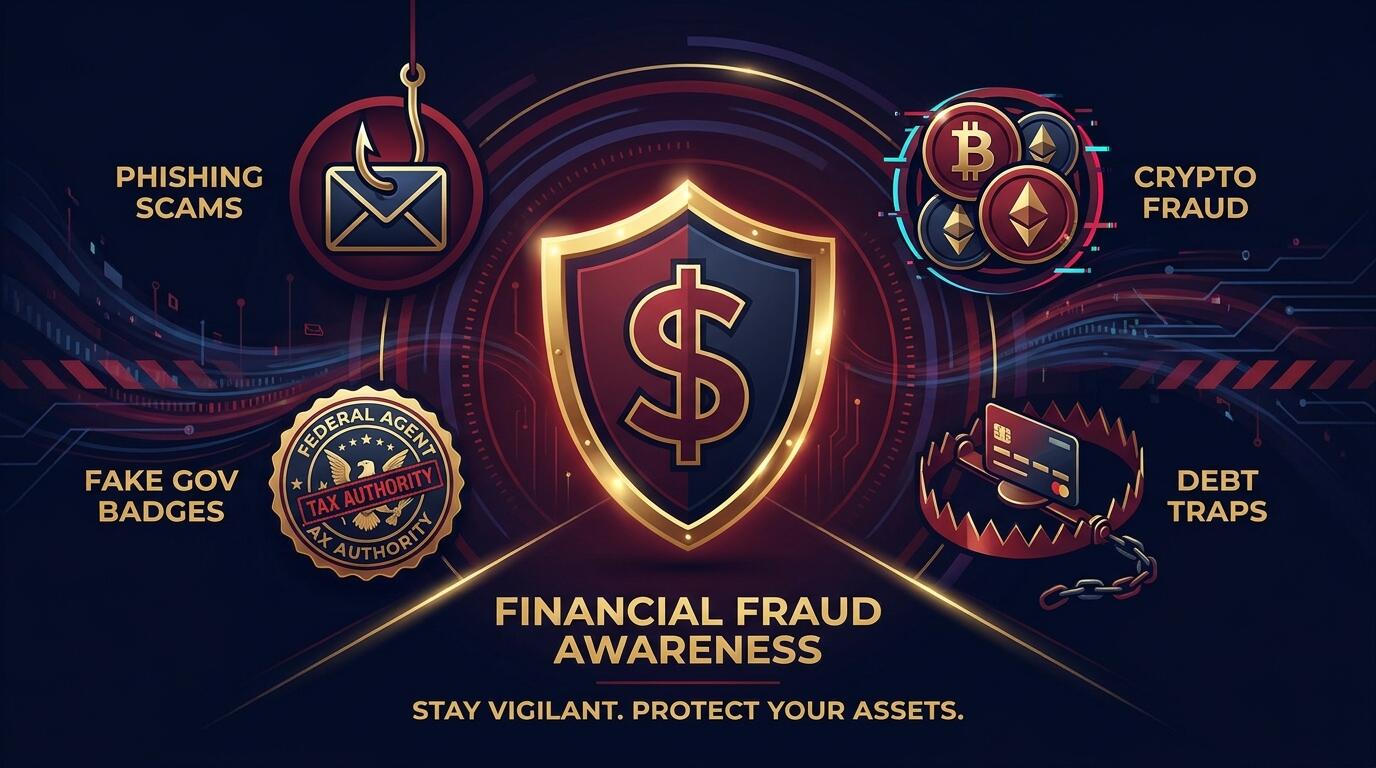
ALT: Common financial scams to watch this quarter — protecting your money from fraud and deception
Why Financial Scams Are Surging — and How to Spot the Most Common Threats This Quarter
Financial scams are deliberately crafted frauds designed to trick individuals into surrendering money, personal data, or account access under false pretenses — and they are growing in sophistication at a pace that outstrips most people's awareness. In our work monitoring financial headlines and explaining economic news to everyday readers, a pattern we consistently see is that scams spike during periods of market uncertainty, major policy shifts, or whenever a new financial trend captures public attention. This quarter is no exception.
This article compares the most prevalent categories of financial fraud circulating right now — investment scams, impersonation scams, banking and phishing fraud, and debt or benefit-related schemes — across four practical dimensions: how they operate, who they target, how convincing they appear, and what red flags to watch for. The goal is not to frighten you, but to give you a clear, structured picture of the threat landscape so that recognition becomes second nature.
How to Evaluate a Financial Scam: The Criteria That Matter
Understanding why a scam works is just as important as knowing what it looks like. Four criteria consistently determine whether a fraud succeeds or fails — and understanding each one arms you against the tactics scammers rely on.
Operational mechanics refers to the specific sequence of actions a scammer takes to draw a target in, establish trust, and extract value. Scams that exploit several psychological levers simultaneously — urgency, authority, and social proof, for example — are far harder to resist than single-angle approaches. Knowing the playbook demystifies the pressure.
Target profile matters because scammers do not cast entirely random nets. They select channels, language, and hooks calibrated to specific demographics. Investment scams disproportionately reach people actively searching for financial opportunity; impersonation scams often focus on older adults or recent immigrants less familiar with how government agencies communicate; debt schemes tend to circle around individuals who have recently experienced financial hardship.
Perceived legitimacy is the measure of how convincingly a scam mimics a real institution, person, or process. The more professional the fake website, the more authentic the caller ID spoofing, and the more precisely the fraudster references real details about your life, the higher the perceived legitimacy — and the higher the risk of compliance.
Red flag density captures how many warning signs are present and how quickly a careful observer can spot them. Some scams are riddled with obvious tells; others are engineered so carefully that even financially sophisticated people get caught. Calibrating your red-flag detector for each category is the practical payoff of this comparison.
Investment and "Get Rich Quick" Fraud
Investment fraud is a category of scam in which perpetrators promise unusually high or guaranteed returns on financial products that either do not exist, are wildly misrepresented, or are structured as pyramid schemes where early participants are paid using later victims' money. This quarter, crypto-adjacent investment fraud and so-called "pig butchering" schemes — where scammers build long-term fake romantic or friendship relationships before steering victims into fraudulent investment platforms — are particularly active, according to consumer protection guidance from the U.S. Federal Trade Commission.
What makes this category especially dangerous is its slow burn. Victims often receive convincing early "returns" that are simply part of the deception, which builds false confidence and encourages larger deposits before the inevitable disappearance of funds.
Government and Agency Impersonation Scams
Impersonation scams involve a fraudster posing as a representative of a legitimate institution — the IRS, the Social Security Administration, Medicare, a bank's fraud department, or even law enforcement — in order to manufacture urgency and demand immediate payment or personal information. The Social Security Administration's Office of the Inspector General consistently ranks these among the most reported scams in the United States.
This quarter, impersonation scams have evolved to include AI-generated voice cloning, where a caller sounds unmistakably like a known government voice or even a family member. The technological barrier to creating these fakes has dropped significantly, making the perceived legitimacy of this scam category exceptionally high.
Phishing, Smishing, and Online Banking Fraud
Phishing is a form of digital deception in which fraudsters send emails, text messages (smishing), or social media messages disguised as communications from legitimate financial institutions, retailers, or government agencies, with the intent of harvesting login credentials, account numbers, or payment card details. This category accounts for a substantial share of consumer financial losses, with the FBI's Internet Crime Complaint Center (IC3) tracking it as a perennial top-reported cybercrime.
Modern phishing campaigns are increasingly personalized — they reference your bank by name, address you correctly, and replicate institutional branding with near-perfect accuracy. A link in a phishing email may lead to a site that looks visually identical to your real bank's portal.
Debt Relief, Student Loan, and Benefit Scams
Debt-related fraud encompasses schemes in which scammers charge upfront fees for debt settlement, credit repair, or student loan forgiveness services that are either never delivered or are services the consumer could have accessed for free through legitimate government programs. With ongoing public discussion around student loan policy and Social Security adjustments — topics we've covered in depth, including Social Security's 2027 COLA and what it means for retirees — fraudsters exploit confusion by positioning themselves as necessary intermediaries.
The Consumer Financial Protection Bureau (CFPB) consistently flags upfront-fee debt relief services as among the most financially damaging scams for middle- and lower-income households, precisely because victims are often already financially stressed when they encounter them.
Head-to-Head Comparison: How These Scam Types Stack Up
Criterion — Investment / Crypto Fraud — Government Impersonation — Phishing & Banking Fraud — Debt Relief Scams
Operational mechanics — Relationship-building, fake platforms, fabricated returns — Spoofed caller ID, urgency, threats of arrest or benefit suspension — Fake emails/texts, cloned websites, credential harvesting — Upfront fees, false promises of forgiveness or repair
Primary target profile — Financially aspirational adults, crypto-curious users — Older adults, recent immigrants, Social Security recipients — Broad — anyone with an online bank or email account — Financially stressed individuals with debt or loan burden
Perceived legitimacy — High (convincing platforms, early fake "returns") — Very high (AI voice cloning, real agency names) — Very high (near-perfect brand replication) — Moderate to high (exploits real policy confusion)
Dominant red flags — Guaranteed returns, pressure to act fast, no verifiable license — Demands for gift card payment, threats of immediate arrest — Suspicious links, generic greetings, urgent account warnings — Upfront fees required, promises of guaranteed results
Typical financial impact — High (often large lump sums or ongoing deposits) — Moderate to high (wire transfers, gift cards) — Variable (can range from small card fraud to full account takeover) — Moderate (fees plus lost time pursuing legitimate options)
Reporting authority — FTC, SEC, CFTC — SSA Office of Inspector General, FTC — FBI IC3, bank fraud departments — CFPB, FTC
The table reveals a telling pattern: perceived legitimacy is high across all four categories, which means the popular advice to "just use common sense" understates how difficult real-time recognition actually is. A scam that sounds official, looks official, and references real details about your account or benefits is not obviously fake — it requires deliberate verification habits, not just intuition.
Investment and crypto fraud tends to produce the largest individual losses because the mechanics encourage escalating commitment. Victims invest a little, see apparent gains, invest more, and lose significantly more before the fraud collapses. By contrast, phishing attacks often target smaller amounts per victim but operate at massive scale, meaning total aggregate losses are also very high.
Debt relief scams occupy a particularly troubling space because they exploit genuine need. People who are already struggling financially are least able to absorb additional losses from fraudulent fees — and the confusion surrounding real government debt relief programs gives scammers plausible cover for their pitch.
ALT: Side-by-side comparison of financial scam types including investment fraud, government impersonation, phishing, and debt relief schemes showing red flags and target profiles
Which Scam Should You Be Most Vigilant About? Scenario Recommendations
Matching your personal situation to the most relevant threat is a practical way to sharpen your defenses without becoming overwhelmed.
If you are actively researching investment opportunities — especially in cryptocurrency, AI-related assets, or high-yield accounts you encountered through social media or an online acquaintance — investment and crypto fraud is your highest-probability threat. The best defense is a simple rule: any investment promising consistent, above-market returns without clearly explaining the underlying mechanism and risk is a red flag, full stop. Legitimate investments are registered and verifiable. The U.S. Securities and Exchange Commission maintains free, public tools to verify whether an investment or advisor is registered.
If you are over 60, a recent immigrant, or a Social Security recipient, government impersonation scams are disproportionately targeted at you. The single most important rule: no legitimate government agency will ever call you and demand immediate payment via gift card, wire transfer, or cryptocurrency. If you receive such a call, hang up. You can always call the agency's official number — found on their official website — to verify independently.
If you manage your banking primarily online or clicked a link in an unexpected text message from your "bank" recently, phishing is your most immediate exposure. Never click links in unsolicited emails or texts; navigate to your bank directly by typing the address into your browser or using the official app. Enable two-factor authentication on every financial account that offers it.
If you carry significant student loan debt or credit card debt and have recently searched for relief options, debt relief scams are actively targeting your search behavior. Legitimate student loan programs are administered through the U.S. Department of Education at no additional cost; credit counseling through non-profit agencies accredited by the National Foundation for Credit Counseling is low-cost or free. Any service charging a large upfront fee to access programs that are publicly available at no charge is almost certainly fraudulent.
Pros and cons of vigilance approaches:
Blanket skepticism is effective but emotionally exhausting and can cause people to dismiss legitimate opportunities.
Category-specific awareness is more sustainable — matching your threat profile to your life situation focuses energy where it is most needed.
Verification habits (calling back on official numbers, checking SEC or CFPB registries, consulting trusted third parties) take time but are the most reliable defense across all categories.
In our experience analyzing financial news patterns, the most scam-resistant readers are not necessarily the most financially sophisticated — they are the ones who have internalized a consistent pause-and-verify habit before any financial action prompted by an unexpected contact.
Q1: How can I tell if an investment opportunity is a scam before I put in any money?
Legitimate investment opportunities are registered with regulatory authorities such as the U.S. Securities and Exchange Commission (SEC) or the Financial Industry Regulatory Authority (FINRA). You can verify registration for free using publicly available tools on the SEC's website or FINRA's BrokerCheck database. Key warning signs include guaranteed or unusually high returns, pressure to act quickly, vague or evasive explanations of how returns are generated, and requests to recruit others — all hallmarks of fraudulent schemes.
Q2: Are government impersonation scams really convincing enough to fool informed people?
Government impersonation scams have become highly convincing due to technologies including caller ID spoofing (which makes calls appear to come from official agency numbers) and AI-generated voice cloning. Even financially aware individuals can be caught off guard in a stressful moment. The best protection is a behavioral rule rather than a knowledge test: if an unexpected caller claims to be a government official and demands immediate action or payment, end the call and contact the agency directly using the number published on their official website.
Q3: How long does it typically take to recover money lost to a financial scam?
Recovery timelines vary widely and, unfortunately, full recovery is not always possible. Wire transfers and cryptocurrency payments are particularly difficult to reverse. The FTC and FBI IC3 recommend reporting losses immediately — the sooner a report is filed, the better the chances of any recovery action. Reporting also helps authorities track patterns and shut down active schemes. If payment was made by credit card, dispute the charge with your card issuer as quickly as possible, as this channel has better consumer protection mechanisms.
The Bottom Line
Three realities define the current scam landscape and should anchor your approach to financial self-protection.
First, sophistication is increasing. Scammers now deploy AI voice cloning, near-perfect brand impersonation, and long-term relationship-building strategies that bypass the obvious red flags most people have been trained to spot. Awareness of how each scam category works — not just what it looks like — is essential.
Second, no demographic is immune, but profiles matter. Investment fraud targets the financially ambitious; impersonation scams target the vulnerable and the trusting; phishing operates at scale across everyone with an inbox; debt scams zero in on the financially stressed. Identifying which category most closely matches your current life situation allows you to focus your vigilance where it is most needed.
Third, verification is the universal antidote. Whether you've received an unsolicited investment pitch, a threatening government call, a suspicious email, or an offer of debt relief, the same core response applies: pause, do not act on the spot, and verify through independent, official channels before doing anything.
If financial headlines around policy changes, interest rates, or benefit programs are creating uncertainty that makes you feel like you might be missing something important — that feeling is precisely what scammers exploit. Staying grounded in reliable, plainly explained financial information is itself a form of fraud prevention.
Stay ahead of the financial news stories that scammers exploit. Visit Vega Brief for plain-English explainers on the economic news that matters most — every story is source-linked, strictly educational, and free of investment advice. Whether markets are moving or personal finance headlines are buzzing, Vega Brief helps you stay informed and financially literate with confidence.
References & Further Reading
U.S. Federal Trade Commission. "Consumer Information on Scams and Fraud."
https://www.ftc.gov
U.S. Securities and Exchange Commission. "Investor Alerts and Bulletins on Investment Fraud."
https://www.sec.gov
Federal Bureau of Investigation — Internet Crime Complaint Center (IC3). "Internet Crime Reports and Fraud Prevention Resources."
https://www.ic3.gov
Note: Fraud tactics evolve rapidly; please check the latest official guidance from relevant authorities and consult qualified professionals for advice specific to your situation.
For educational purposes only. Not investment advice. We do not recommend any stock, fund, broker or trading platform. Headlines are sourced from Google News · Business; every story links to the original publishers.